

 Newsletter
If you look at the global energy conversation right now, nuclear power is quietly back in the room. Not with promises or activist slogans, but with a very practical pitch. Countries want clean power that works at night, during monsoons, and when grids are under stress. And that brings us to a yellow, boring-looking rock that suddenly matters a lot again. Uranium.
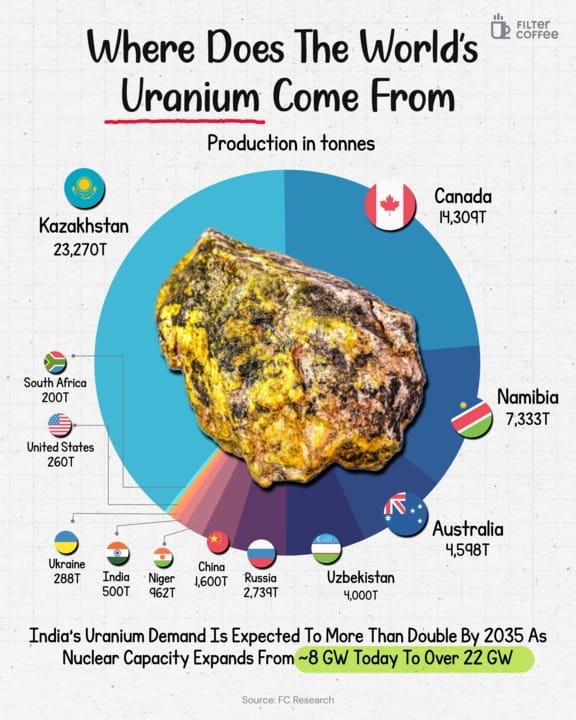
Most of the world’s uranium comes from just a handful of countries. Kazakhstan alone supplies a massive chunk of global production. Canada, Namibia, Australia and Uzbekistan follow. After that, the numbers fall off sharply. India, despite being a nuclear power with ambitious plans, is barely a sliver on that chart.
That contrast matters more today than it ever did before.
For years, nuclear energy was treated like a retired superstar. Useful, but controversial. Reliable, but politically awkward. Then the world ran into three problems at once. Climate targets started looking serious. Energy security became a real concern after geopolitical shocks. And electricity demand exploded, thanks to data centres, EVs, AI, and plain old urban growth.
Suddenly, nuclear power was back in the conversation. Not as a perfect solution, but as a dependable one.
This global shift has quietly pushed uranium back into focus. Unlike oil or gas, uranium is not traded openly every day on exchanges. Most of it moves through long-term contracts. Supplies are planned years in advance. It means when demand rises faster than expected, the system does not adjust smoothly. It tightens.
That tightening is already visible.
The world’s largest uranium producer has said it plans to hold back on production growth. Some major mining regions are dealing with political instability. Parts of Africa, which supply Europe, are seeing disruptions that have nothing to do with geology and everything to do with governance. Even transport routes have become uncertain.
In simple terms, more countries want uranium. Fewer places control it. And those places are not always predictable. This is exactly where India’s nuclear plans start to collide with global reality.
India’s nuclear capacity today is roughly 8 gigawatts. The government wants this to cross 22 gigawatts by the early 2030s and eventually hit 100 gigawatts by 2047. That is not a small upgrade but rather a full-scale expansion.
In fact, the Union Budget for 2025–26 backed this shift with a ₹20,000 crore allocation for developing and deploying at least five indigenously designed small modular reactors by 2033.
Nuclear power runs round the clock. It doesn’t wait for the sun or the wind. And unlike coal, it cuts emissions without making the grid fragile. For a fast-growing economy that can’t afford power cuts, that combination is hard to ignore.
That’s where the mismatch begins.
India does not produce enough uranium to fuel this ambition on its own.
Domestic uranium mining exists, but it is limited and slow to expand. Mining is complex. Clearances take time. Output grows gradually, not dramatically. So as reactors increase, imports have to fill the gap.
To support this expansion, India plans to nearly quadruple uranium imports by 2033. Government estimates suggest at least 9,000 metric tonnes of uranium will be imported between 2025 and 2033 to fuel new reactors under the National Nuclear Energy Mission.
This is already happening.
India imports uranium from multiple countries through long-term agreements. Kazakhstan, Canada, Uzbekistan and others feature in this mix. The goal is not just volume, but diversification. Relying on one supplier is risky in a world where energy is increasingly geopolitical.
They are strategic insurance policies.
At the same time, India is trying to play a longer game.
Instead of only focusing on buying more uranium, India has spent decades figuring out how to use less of it. This includes recycling spent fuel, developing fast breeder reactors, and eventually tapping thorium reserves. The goal is: get more energy out of every kilogram of uranium.
This is not some distant dream. India has already crossed key milestones in advanced reactor technology. These steps do not eliminate the need for uranium imports, but they reduce vulnerability over time.
There is also another quiet shift underway.
Nuclear power in India has traditionally been a state-only affair. That is changing. The government has started opening doors for private participation, especially in new reactor designs like small modular reactors. More players mean faster capacity addition. But they also mean fuel planning becomes even more critical.
More reactors mean more uranium contracts. More long-term commitments. More pressure to secure supply before the rest of the world does.
This is where the image fits perfectly into the story. When demand rises globally and supply stays concentrated, access becomes power.
India’s small slice does not mean weakness. The country is betting on nuclear power as a pillar of its energy future. But that bet only works if fuel security is locked in early, diversified smartly, and backed by technology that reduces dependence over time.
So the next time you see that uranium rock sitting quietly in the middle of a circle, remember this. It is not just a mineral. It is a reminder that energy transitions are not built only with solar panels and wind turbines. They are built with contracts, diplomacy, planning, and yes, rocks that decide who keeps the lights on.
FAQs
Why is uranium important for nuclear power?
Uranium is the primary fuel used in nuclear reactors to produce electricity. When uranium atoms split, they release large amounts of energy, which is used to generate stable, round-the-clock power without carbon emissions.
Which countries produce the most uranium in the world?
Global uranium production is highly concentrated. Kazakhstan leads by a wide margin, followed by Canada and Australia. Countries like Namibia and Uzbekistan also contribute, but production drops sharply beyond the top few producers.
Why is uranium supply considered concentrated if it exists worldwide?
Uranium is found in many places, but only a few countries have deposits that are economical to mine at scale. Factors like ore quality, mining costs, regulations, and political stability limit where usable uranium actually comes from.
How much nuclear power capacity does India currently have?
India currently has around 8 gigawatts of installed nuclear power capacity. This is relatively small compared to its total electricity demand and long-term energy goals.
What are India’s nuclear power targets for the future?
India aims to expand nuclear capacity to over 22 gigawatts by the early 2030s and reach around 100 gigawatts by 2047 as part of its long-term energy security and clean power strategy.
Why does India need to import uranium?
India’s domestic uranium production is limited and not sufficient to support a large-scale nuclear expansion. As a result, India relies on long-term uranium imports to fuel its reactors.
How much uranium does India plan to import in the coming years?
India plans to import at least 9,000 metric tonnes of uranium between 2025 and 2033, nearly quadrupling current import levels to support new nuclear reactors under the National Nuclear Energy Mission.
What did the Union Budget 2025–26 announce for nuclear energy?
The Union Budget 2025–26 allocated ₹20,000 crore for the development and deployment of at least five indigenously designed small modular reactors by 2033, signalling strong government backing for nuclear power.
How is India trying to use uranium more efficiently?
India focuses on recycling spent nuclear fuel, developing fast breeder reactors, and eventually using thorium-based technology. The aim is to generate more energy from limited uranium resources over the long term.
Why does global geopolitics matter for uranium supply?
Uranium supply depends on a few countries, some of which face political instability or policy shifts. As global demand rises, disruptions or production cuts in these regions can directly impact fuel availability and prices for nuclear-powered countries like India.