

 Newsletter
India is sitting on a lot of gold. Quite literally.
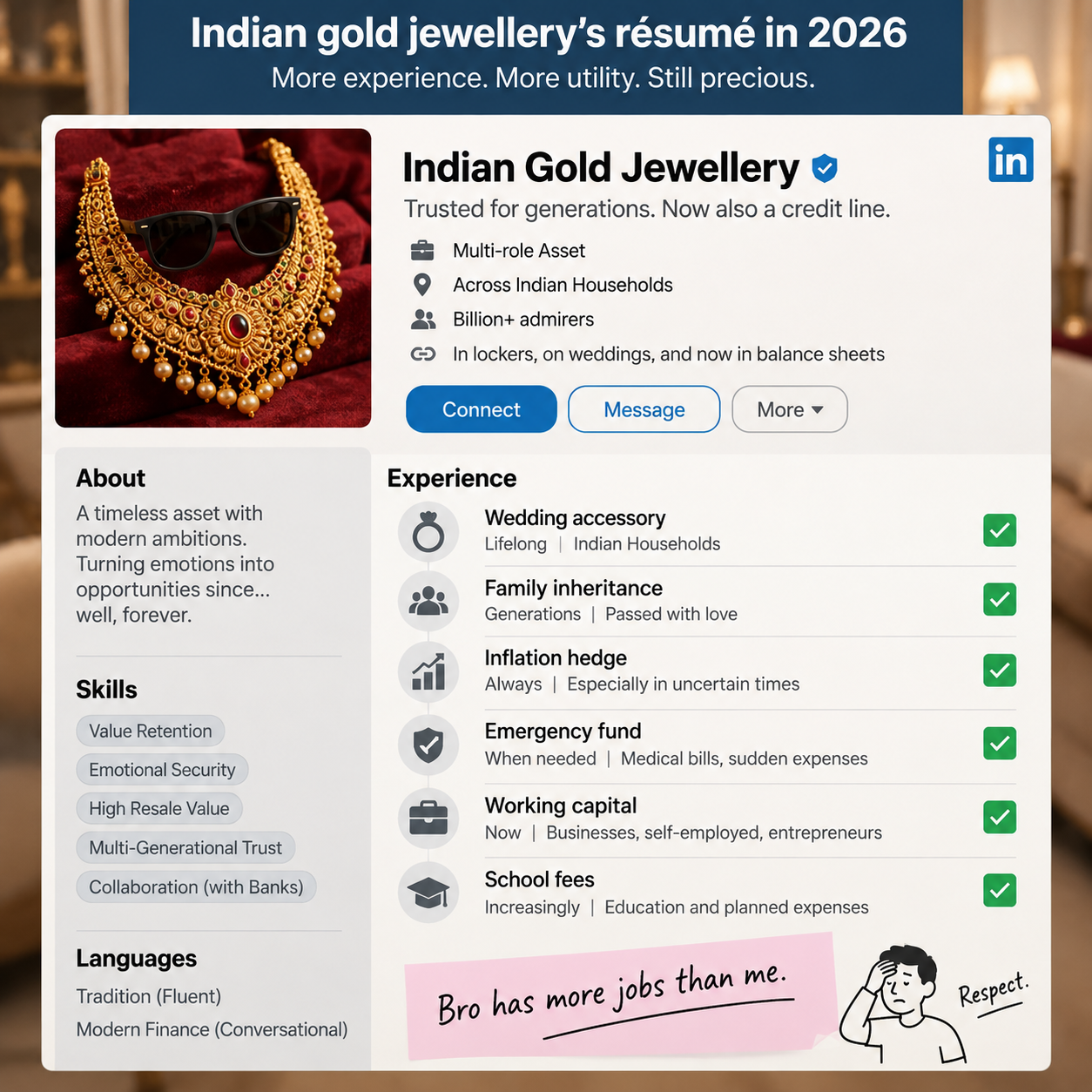
Indian households are estimated to own as much as 25,000 tonnes of it, much of it sitting in cupboards, lockers and jewellery boxes. For years, that gold mostly did three jobs: jewellery, savings and family inheritance.
Increasingly, it is doing a fourth. It is becoming collateral.
By July 2026, NBFCs had nearly ₹3.54 lakh crore of loans outstanding against gold jewellery, up 68.5% from a year earlier. Banks had another ₹5.52 lakh crore outstanding, with their gold-loan books up 88.1% YoY. Gold was the fastest-growing major retail lending category for NBFCs.
And this is happening while India is getting richer, more banked and more digital. You would think borrowing against your jewellery would slowly disappear. Instead, India has turned one of its oldest ways of borrowing money into one of its hottest formal lending businesses.
The gold loan is much older than Muthoot: Borrowing against gold is hardly new in India.
Before credit scores, instant personal loans or lending apps, jewellery worked as a household credit line. A family that needed money could take gold to a local moneylender, pawnbroker or jeweller and borrow against it.
The attraction was: you did not need to sell the jewellery permanently, and the lender did not need to know much about your salary or credit history. The gold sitting in front of them was the security. That made the product particularly useful in rural India and among self-employed households, where formal credit was harder to access.
For much of its history, though, this business remained informal. World Gold Council estimates suggest that even as recently as 2022, roughly 60% of India's gold-loan market was still controlled by informal lenders. The entire market was estimated to have 2,950 to 3,350 tonnes of gold pledged as collateral by early 2023.
That is the base from which India's organised gold-loan industry grew. Companies such as Muthoot Finance and Manappuram Finance took something the local moneylender had been doing for generations and turned it into a scalable financial product.
The borrower would walk into a branch with jewellery. The lender would check its purity and weight, calculate how much could safely be lent against it, store the jewellery and hand out the loan. Little credit history was required because the jewellery itself reduced the lender's risk.
And as branch networks expanded, an informal financial habit started moving into the formal system.
Then RBI started paying attention: By the early 2010s, gold lending had become large enough to make regulators nervous.
India was importing huge quantities of gold, while specialist gold-loan NBFCs were growing rapidly. RBI worried about the sector's dependence on one asset and the risks that could emerge if gold prices fell sharply.
So in March 2012, it capped the loan-to-value ratio for NBFC gold loans at 60%.
Loan-to-value, or LTV, is basically how much money you can borrow against the gold.
If the eligible value of your jewellery was ₹1 lakh, a 60% LTV meant an NBFC could lend you only ₹60,000. RBI tightened other rules too. Gold had to be valued more consistently, lenders needed stronger systems around storage and auctions, and loans could not simply be given against bullion or for buying more gold.
By January 2014, RBI relaxed the NBFC ceiling to 75%. Banks were also capped at 75%, putting the two types of lenders on a more comparable footing. The organised industry had survived its first big regulatory shake-up. Then COVID arrived.
COVID gave gold loans a different job: In 2020, millions of households and small businesses suddenly needed cash. Banks were cautious. Incomes were uncertain. Businesses had shut. But many households still had one valuable asset at home: Gold.
RBI temporarily increased the maximum LTV on certain bank gold loans from 75% to 90%, specifically to ease financial pressure on households, entrepreneurs and small businesses. The relaxation lasted until March 31, 2021.
Gold loans became an obvious way to raise money quickly without selling jewellery outright. Commercial-bank consumer loans against gold jewellery had reached ₹73,800 crore by May 2022, nearly three times their 2019 level, according to World Gold Council data.
The pandemic also pushed more of the business into organised lending. Formal lenders controlled roughly 35% of India's gold-loan market in 2019. By 2022, their share had risen to about 40%.
That left one habit firmly established: gold could be used for liquidity without being sold. The latest boom is taking that behaviour much further.
Now the price of gold is doing the heavy lifting: Gold prices surged through FY26. ICRA estimates average prices rose nearly 60% YoY, after rising 33% the previous year.
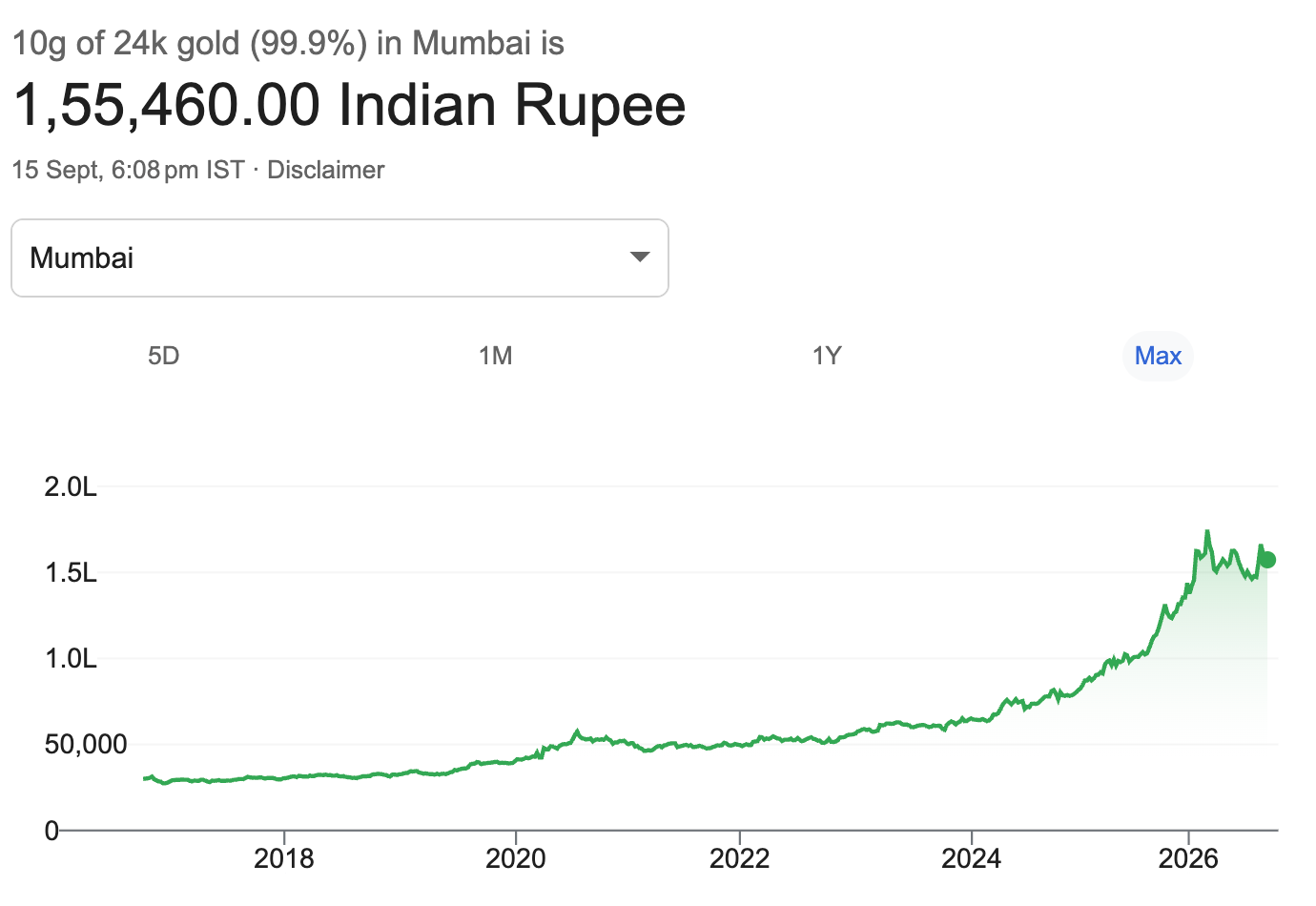
For existing gold owners, this creates a useful effect. Imagine jewellery that could support a ₹60,000 loan a few years ago. If the underlying gold becomes substantially more valuable, the same jewellery can support a larger loan even if the borrower has not bought another gram.
India suddenly has trillions of rupees of additional borrowing capacity sitting inside jewellery boxes. Lenders like this arrangement too. Unlike a personal loan or credit-card balance, a gold loan has a physical asset behind it.
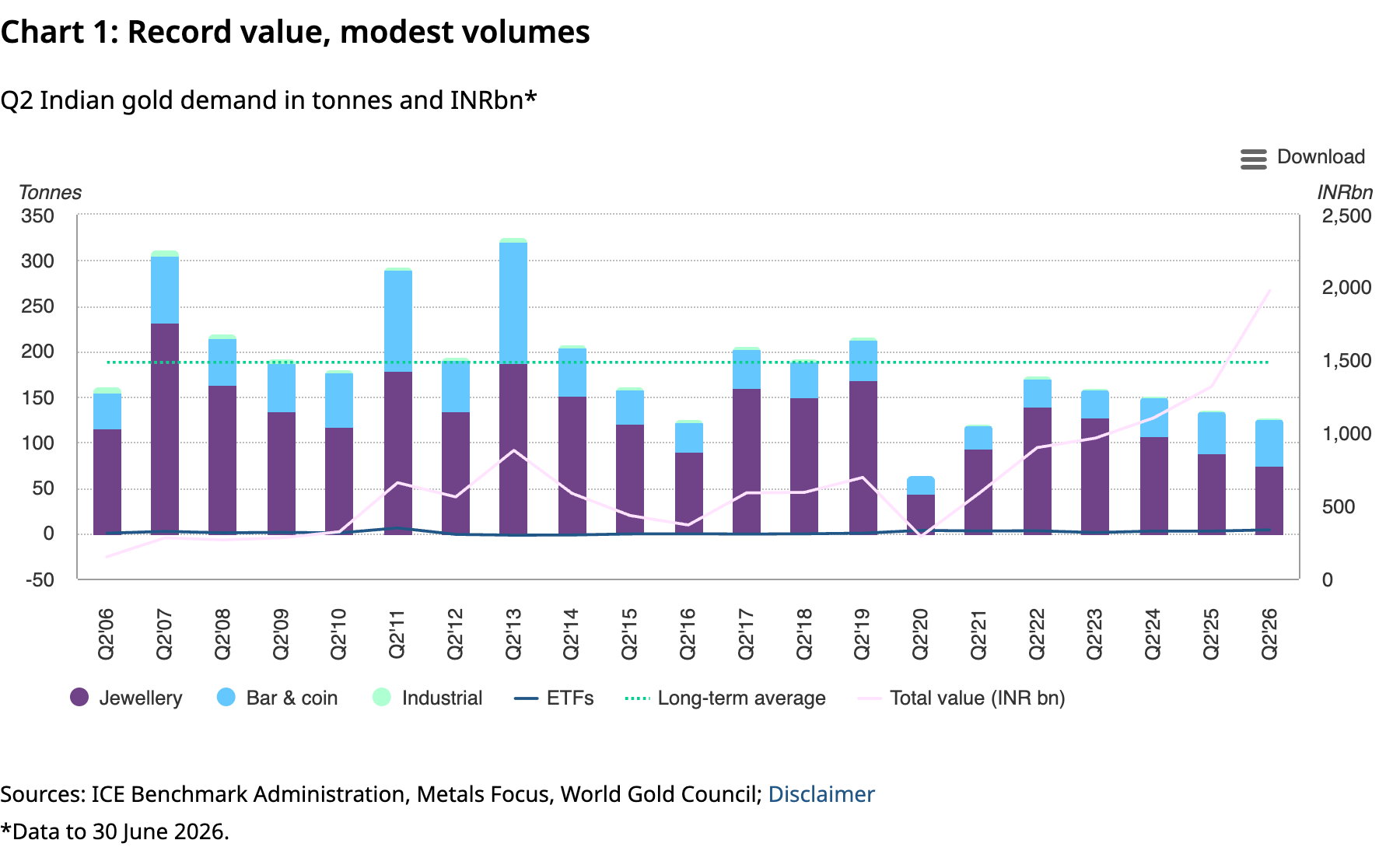
And despite gold becoming much more valuable, people do not appear particularly eager to sell it. India recycled just 19 tonnes of gold during Q2 2026, down 17% YoY and the lowest level in eleven quarters, according to the World Gold Council. That happened even though domestic gold prices were around 60% higher than a year earlier.
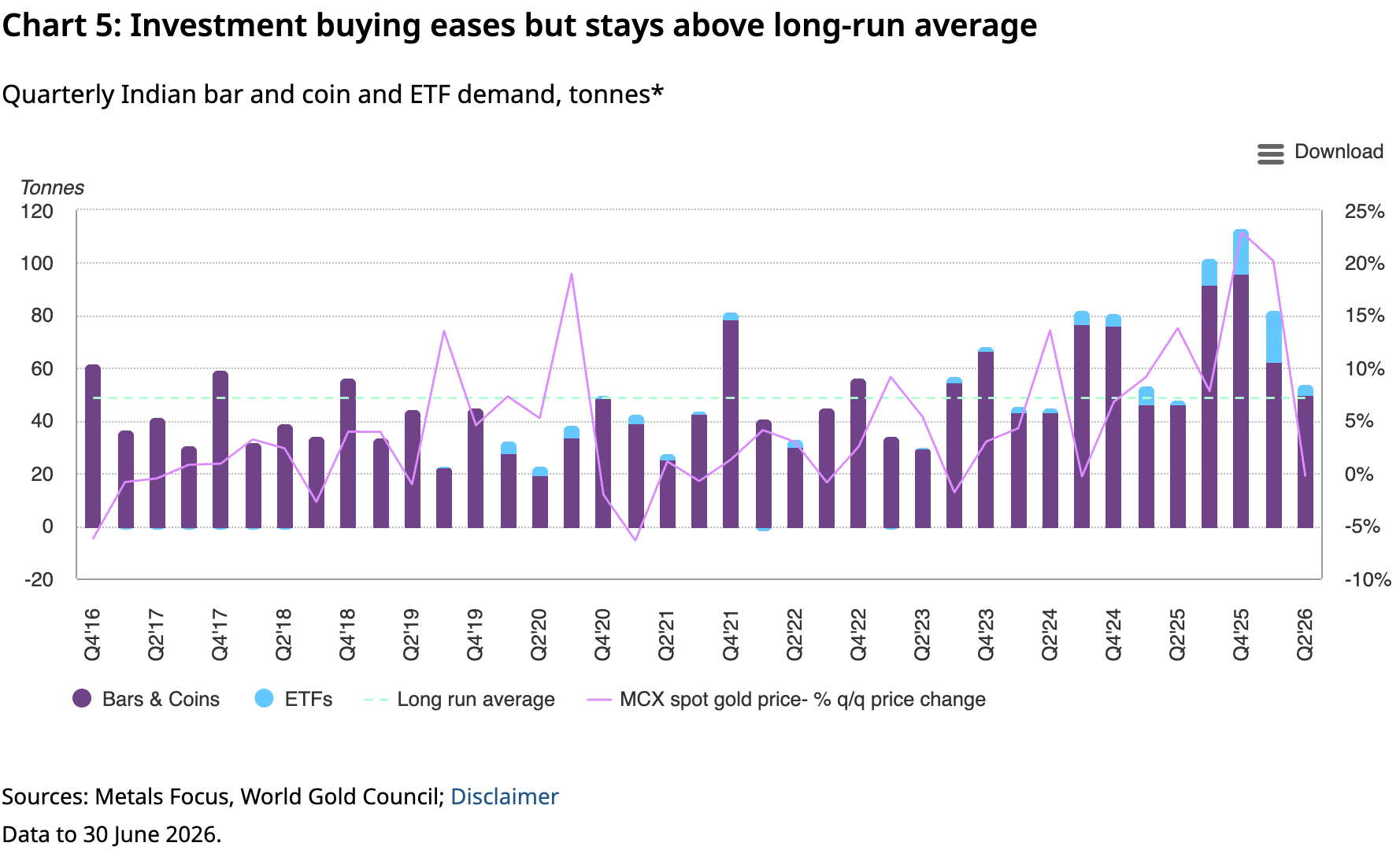
Instead, households have another option: pledge the gold, get the money and retain ownership of the jewellery.
By May, banks already had ₹5.1 trillion of outstanding gold loans, up 105% YoY. NBFCs had ₹3.3 trillion, up 70%. World Gold Council says gold loans have become India's second-largest retail lending segment after housing.
Two months later, NBFC gold loans had climbed further to ₹3.54 trillion.
And people are borrowing for more than emergencies.
Like education, business working capital and other planned expenses as growing uses of gold-backed credit.
The market could get much larger: ICRA expected India's organised gold-loan market to reach around ₹15 trillion in FY26, after growing at roughly 26% CAGR during FY24 and FY25.
By July 2026, its outlook had become even more aggressive. The ratings agency now expects organised gold-loan assets to reach ₹30 trillion by FY28. Part of that growth will come naturally if gold prices remain elevated. But there is also plenty of untouched collateral.
Households own up to 25,000 tonnes of gold, while only a fraction is pledged through formal lenders. Banks want that customer. Traditional gold-loan NBFCs want that customer. Fintechs want to make the borrowing process faster. And organised lenders are pushing deeper into smaller cities, towns and rural markets where physical gold ownership is high.
RBI is simultaneously trying to make the rules more consistent. Its 2025 gold and silver lending framework consolidated standards around valuation, collateral handling and lending practices across regulated institutions. The regulator has spent years trying to make sure the industry grows without turning rising gold prices into careless lending.
There is a good reason for that caution.
Gold prices do not only move upwards. If prices fall sharply after lenders have advanced large sums against jewellery, their collateral cushion shrinks.
So far, lenders appear to have room. World Gold Council estimates suggest average LTVs were around 55% for banks and 60% for NBFCs in March 2026, well below the maximum permitted levels.
Still, the current boom is partly riding on an unusually strong gold market. A sustained correction would test how much of this growth came from genuine new borrower demand and how much simply came from more expensive collateral.
India has tried to unlock household gold before: Successive governments have spent years trying to put India's enormous private gold stock to productive use. Schemes such as the Gold Monetisation Scheme tried convincing households to deposit idle gold into the financial system. Uptake remained modest.
Gold loans found a less complicated route. They do not require Indians to give up an asset many families are emotionally reluctant to sell. The jewellery goes into a lender's vault. The money comes out. Repay the loan and the jewellery comes home. That arrangement is ancient. However, the scale is not.
What began with pawnbrokers and neighbourhood moneylenders is now a ₹9 lakh crore-plus lending business across banks and NBFCs, based on July 2026 outstanding balances. And organised gold loans could become a ₹30 trillion market within two years if ICRA's projections hold.

India's relationship with gold has therefore picked up another layer. We still buy it for weddings. We still pass it down through families. We still reach for it when markets or currencies feel shaky. Increasingly, we are also making it work for us without actually letting it go.
Sources
- Reserve Bank of India (RBI) - Gold loan regulations, loan-to-value rules and historical regulatory changes
- World Gold Council - India’s household gold holdings, gold-loan market, pledged gold estimates and 2026 gold demand data
- ICRA - Organised gold-loan market estimates, FY26 growth and projections through FY28
- Business Standard - Bank and NBFC gold-loan outstanding balances and 2026 growth
- ET JewelleryWorld - Changing use of gold loans for education, working capital and planned expenses; expansion into smaller towns and semi-urban markets
- Muthoot Finance - History and development of organised gold lending in India
- Manappuram Finance - Company history and evolution of the organised gold-loan business
- Press Information Bureau - Historical gold imports, import duties and government measures during the 2012-13 period