
 Newsletter
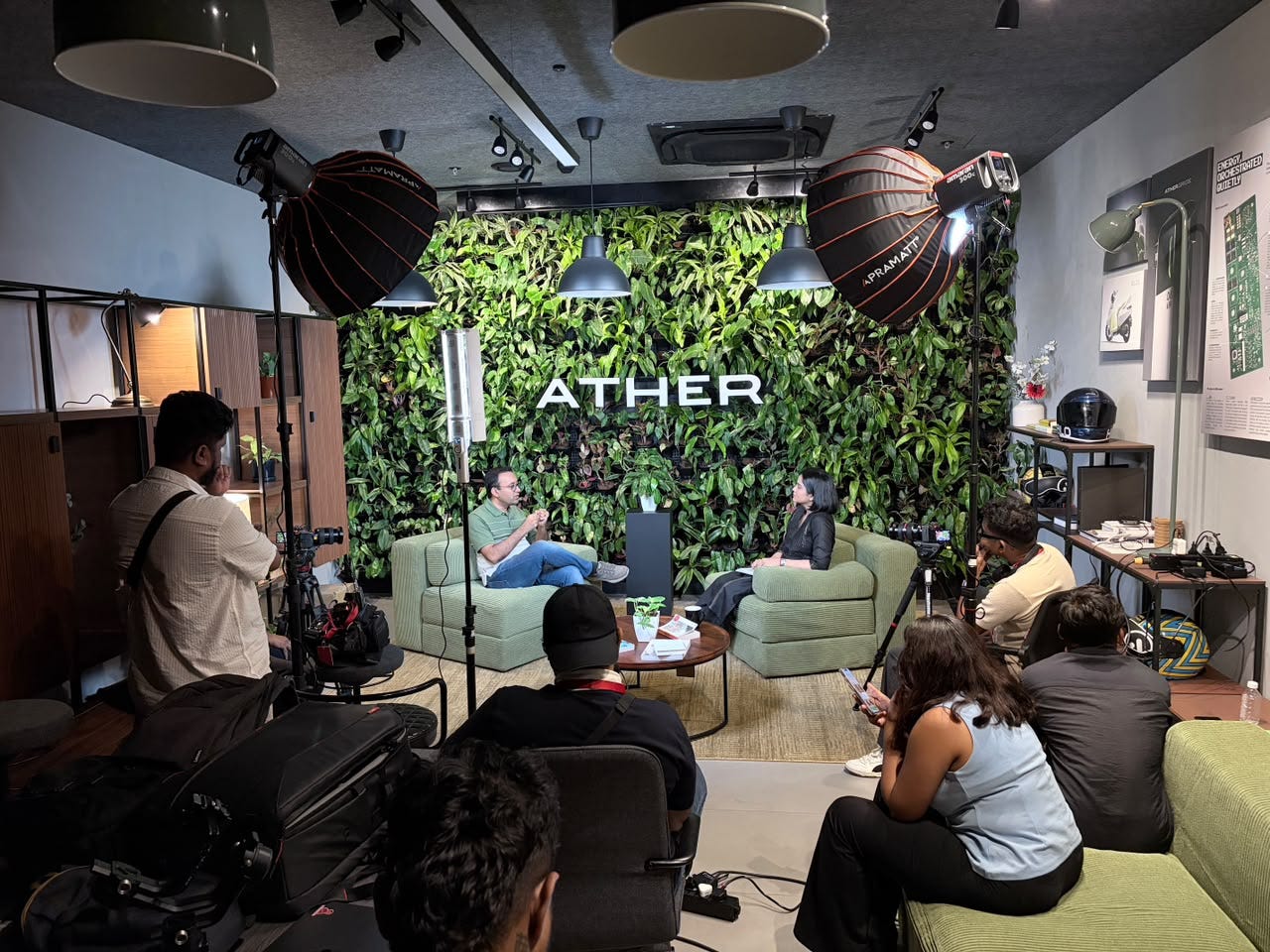
It took us nearly six months to finally get Ather on This Is Business.
Dates moved, calendars refused to cooperate, and just when the shoot seemed locked, something else would come up. Then one day, an email landed in our inbox: “The podcast is on!!!” A few days later, we were on a flight from Mumbai to Bengaluru.

By the time we reached Ather’s headquarters, the company we had spent weeks researching looked very different from the one that had started 13 years earlier.
Watch the episode here:
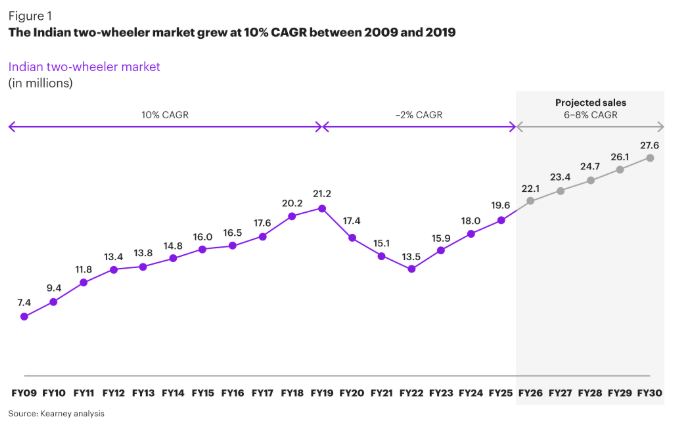
Back in 2013, electric scooters were already being sold in India, but hardly anyone was buying them at scale. Companies such as Yo Bykes and Hero Electric had been around for years, yet the entire electric two-wheeler market was still only around 1 lakh vehicles annually. For context, India’s broader two-wheeler industry was already producing more than 84 lakh vehicles a year by FY09.
Most buyers still preferred petrol scooters. Early electric models were typically slower, offered limited range and often relied on lead-acid batteries. The category existed, but it had not become a serious alternative for the average Indian rider.
Elsewhere in Asia, the contrast was sharp. China sold about 9.4 million electric scooters in 2013, roughly 78% of the 12 million sold globally that year. Electric two-wheelers there were already part of everyday urban transport. Taiwan was smaller, but its government had been promoting electric scooters since 2009 and supporting newer ownership models. Gogoro, founded in 2011, later pushed that idea further with battery swapping. By 2015, Taiwan was selling more than 10,000 electric scooters a year and had a fleet of around 43,000.
China had shown that electric two-wheelers could scale. Taiwan was experimenting with how they could be easier to charge and own. India was still trying to get people interested in buying one. That was the market Ather entered.
Ather spent the next few years trying to change what an electric scooter could feel like. Before the first production version of the Ather 450 reached customers in 2018, the company had built its own battery packs, battery management systems, software and charging infrastructure.
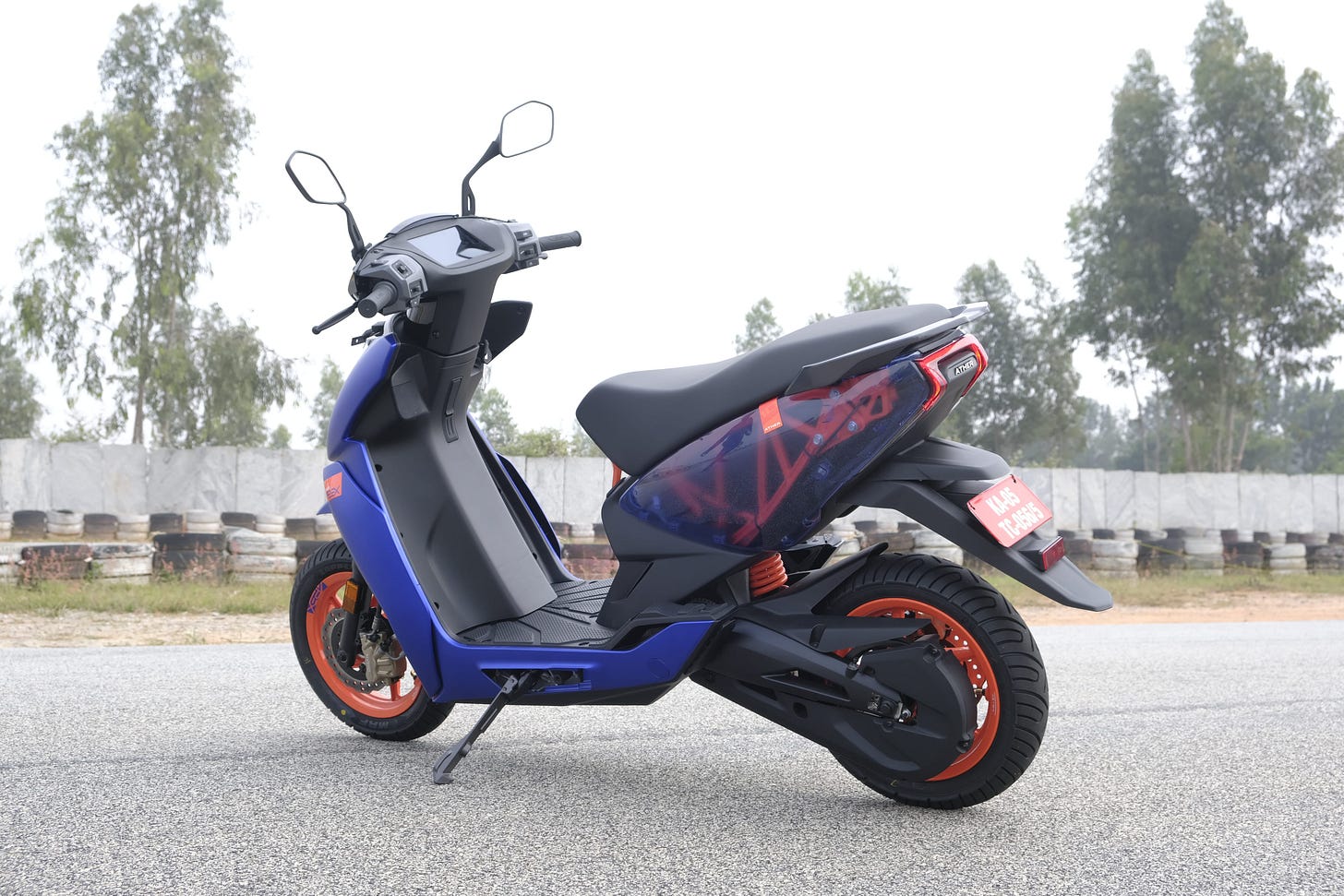
The 450 looked very different from what many Indian buyers associated with EVs at the time. It used a lithium-ion battery, had a touchscreen dashboard, navigation, connected software and over-the-air updates, and could reach 80 km/h. Ather also built Ather Grid, its own fast-charging network, because the ownership experience would remain incomplete if customers still had nowhere convenient to charge.
“Not because I think we had very clear philosophies... every time we didn’t find something in the market, we just said, ‘Theek hai, toh usko bana lete hain.’” - Tarun Mehta, CEO of Ather Energy
The scooter was not cheap. The first 450 cost roughly ₹1.25 lakh on-road in Bengaluru in 2018, while many petrol scooters cost much less. Ather was effectively asking customers to pay for performance, software and a more polished ownership experience rather than choosing electric only for lower running costs.
“Your salary is ₹3 lakh per annum, ₹8 lakh, ₹20 lakh, ₹50 lakh... your bum is still on a scooter or a motorcycle because there’s no better way to navigate our cities.” - Tarun Mehta, CEO of Ather Energy
That helped shift the perception of the category. Electric scooters had mostly been sold around savings or environmental benefits. Ather pushed performance and technology to the centre of the pitch and tried to make electric feel like an upgrade rather than a compromise.
Over the next few years, the market itself began to catch up. The government increasingly saw electric mobility as a way to reduce dependence on imported petroleum, cut urban pollution and build a domestic EV and battery industry. FAME-I arrived in 2015, followed by the much larger ₹10,000 crore FAME-II scheme in 2019, which offered incentives for electric two-wheelers, cars, buses and charging infrastructure.
Ather 450 is possibly one of the most important scooters to have been built because it really started the EV two-wheeler revolution - Tarun Mehta, Ather.
Products were improving too. Lithium-ion batteries became more common, charging infrastructure expanded and high petrol prices strengthened the running-cost case for switching. The change was no longer limited to scooters. Electric cars were beginning to find buyers as well, especially after Tata launched the Nexon EV in 2020. India’s electric passenger-vehicle sales rose from 4,984 units in FY21 to 17,802 in FY22, while electric two-wheelers were growing much faster alongside them.
By then, the category was attracting much larger players. Ola Electric entered with aggressive pricing and huge manufacturing ambitions. TVS expanded iQube. Bajaj brought back the Chetak as an electric scooter. Hero MotoCorp launched Vida. Honda eventually entered too. A market that had once been dominated by a handful of EV-focused companies was becoming a serious battleground for India’s biggest two-wheeler manufacturers.
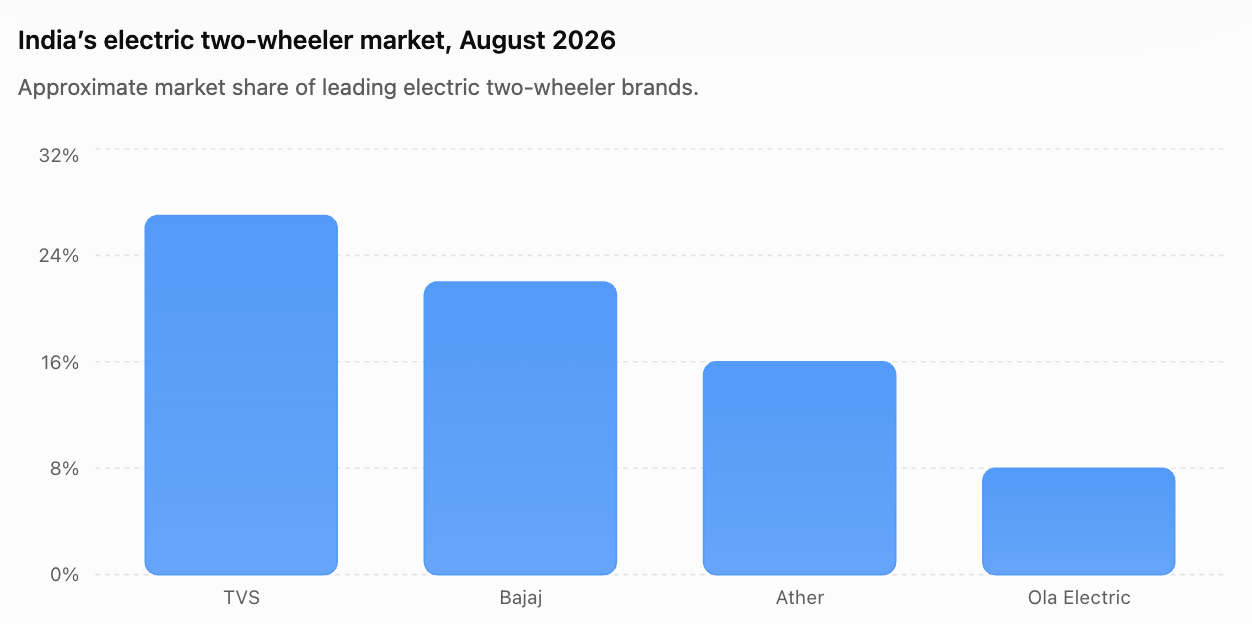
By August 2026, electric two-wheelers had crossed 10% of India’s two-wheeler retail market in a non-festive month for the first time. Indians had already bought around 13.6 lakh electric two-wheelers in the first eight months of the year, more than the roughly 13.4 lakh sold during all of 2025.
The competitive order had changed just as quickly. TVS and Bajaj now occupied the top two spots, Ather had moved into third, while Ola’s share had fallen sharply. For Ather, the category it had helped modernise was finally becoming mainstream, but a growing share of that market was now being captured by traditional two-wheeler companies with far deeper manufacturing and distribution networks.
That shift also changed the kind of customer Ather needed to win. For years, the 450 had defined the company. It was sporty, tech-heavy and aimed at buyers who valued performance and software. But the larger Indian scooter market cared about a different set of things: comfort, storage, family use, price and easy servicing.
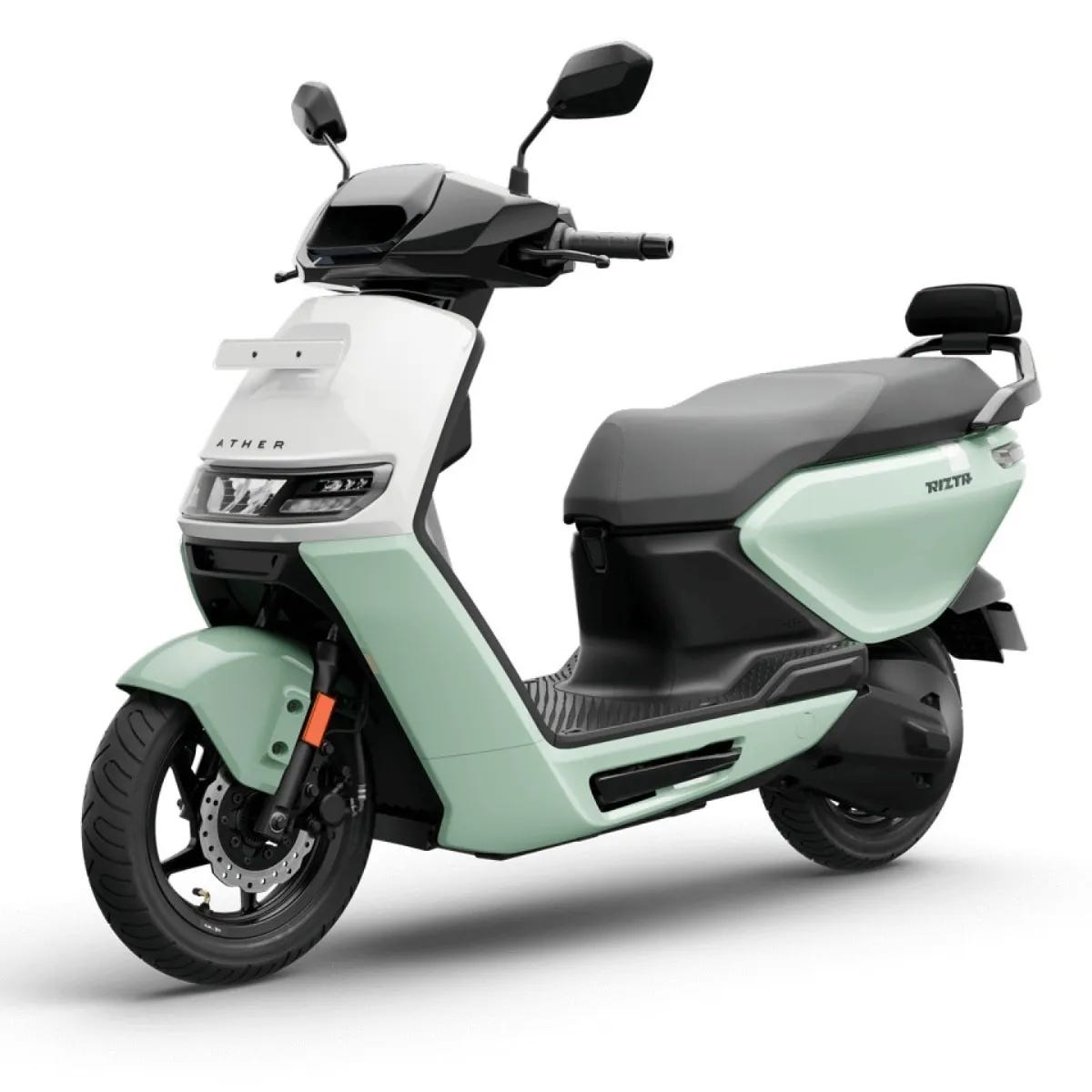
The clearest sign of Ather adapting came in 2024 with Rizta. The product itself was less important than the customer it targeted. Ather was moving beyond enthusiasts and early adopters and towards the kind of buyer who might otherwise walk into a TVS, Honda or Suzuki showroom.
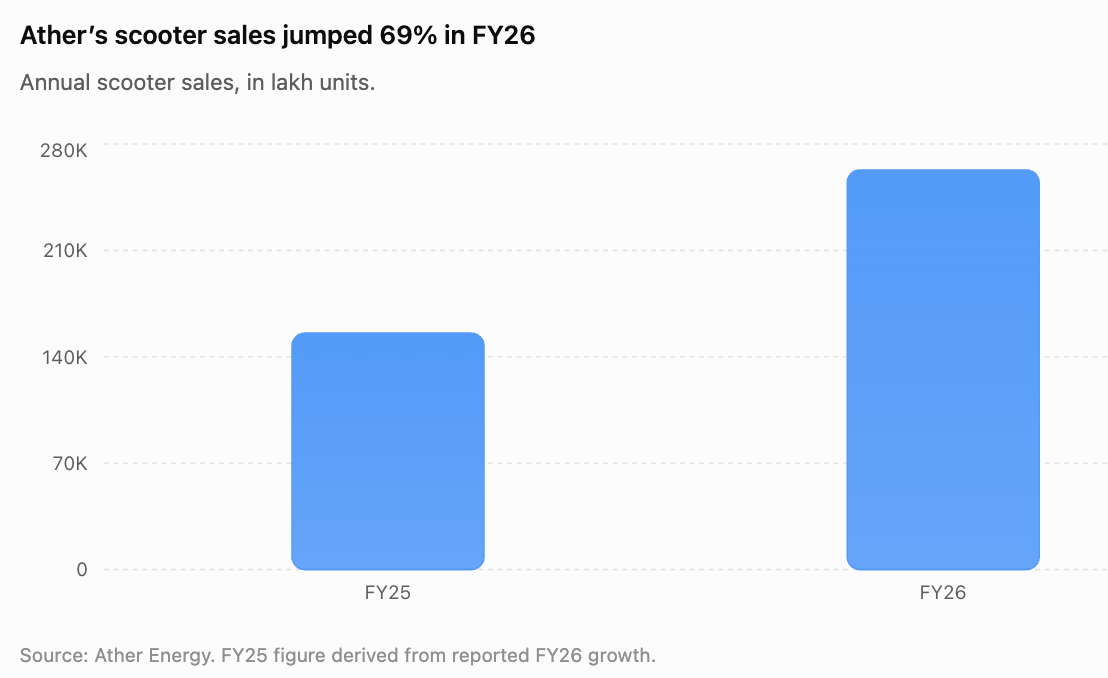
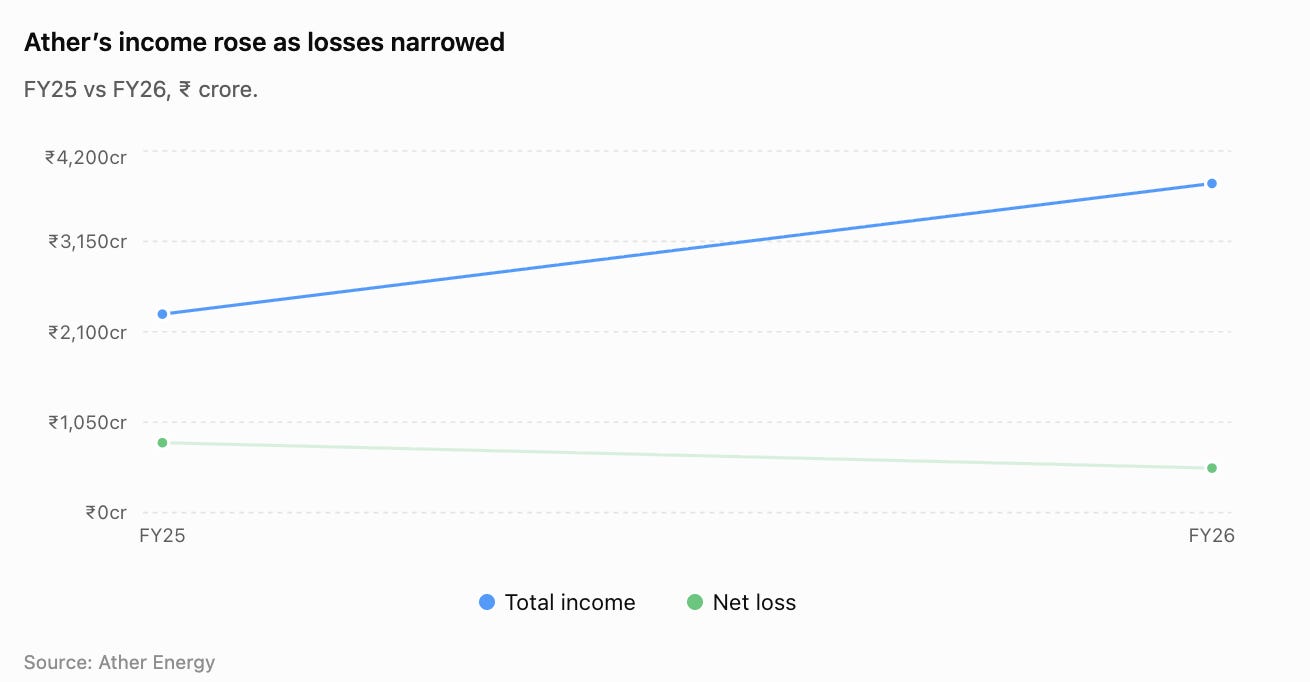
The shift translated into scale. Ather sold 2,62,942 scooters in FY26, up 69% from the previous year. Total income rose 66% to ₹3,823 crore, while its share of India’s electric two-wheeler market reached 18.6%. Ather also gained ground outside its traditional southern strongholds as it added more stores in markets such as Gujarat, Odisha, Maharashtra, Madhya Pradesh and Chhattisgarh.
As electric scooters become mainstream, buyers care less about the fact that they are electric. They still care about range and charging, but those features increasingly sit alongside the same questions that have always shaped scooter purchases: price, comfort, reliability, service and resale value.
That leaves Ather with a different problem from the one it started with. The next phase is less about proving what an electric scooter can do and more about reducing costs, sharing more components across models and making manufacturing easier to scale. That logic is visible in Ather’s newer EL platform, with Konarc as the first product built on it. Using the same underlying architecture across multiple models can spread development costs, simplify manufacturing and improve purchasing power with suppliers.
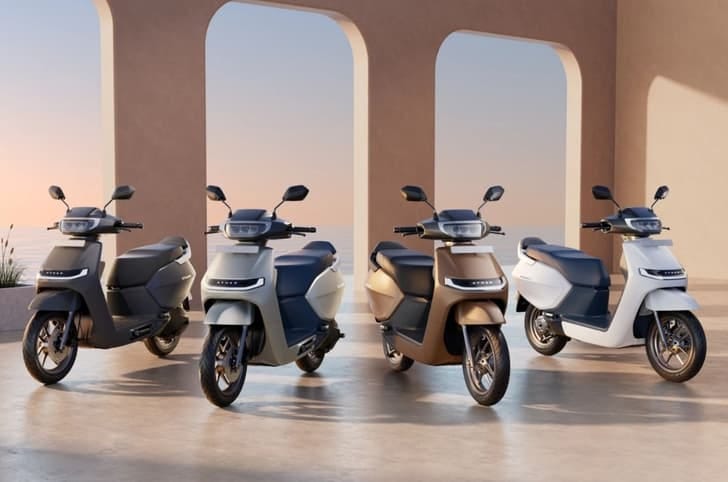
Ather is now dealing with the economics of becoming a large automobile company. It has to think about how many parts go into a scooter, what each component costs, how quickly a vehicle can be assembled, how easily it can be repaired and how many models can come from the same engineering base.
The problem is that TVS and Bajaj have been refining those skills for decades. They already have large supplier networks, factories, dealer relationships and service infrastructure. Their profitable petrol businesses can fund the EV transition while their electric divisions grow. Ather has had to build much more of that ecosystem itself.
By March 2026, Ather had expanded to around 700 Experience Centres. Software, charging, accessories, spares and services contributed 13% of total income, while adjusted gross margin improved from 19% to 24% during FY26.
Software is one area where Ather has managed to monetise beyond the vehicle itself. In Q4 FY26, 93% of buyers opted for AtherStack Pro, its paid software package. Charging, servicing, accessories and insurance add more revenue after the initial sale, giving the company more ways to earn from each customer over the ownership cycle.
The problems customers bring to Ather have also become more mature. A decade ago, buyers worried about range, speed and whether the battery would survive everyday use. Today, the conversation includes apartment charging, vehicle health scores, battery warranties and resale value. Those are the questions that appear when EV ownership starts moving beyond enthusiasts and into the mainstream.
Ather still has to prove that scale can turn into sustainable economics. The company reported a net loss of ₹517 crore in FY26, down from ₹812 crore a year earlier, while EBITDA losses narrowed sharply. Developing a scooter, building factories and employing engineers carry large fixed costs whether a company sells 50,000 vehicles or 3 lakh. Higher volumes spread those costs across more scooters, which improves the economics if manufacturing costs keep falling at the same time.
That is why Ather’s recent shift towards broader products, common platforms and a larger retail network is as much about cost as it is about growth. The company has already shown that it can build a sophisticated EV. The harder test is whether it can produce and sell enough of them, at the right price, while keeping service quality intact and losses moving down.
Hero MotoCorp adds an unusual layer to that story. Hero has been one of Ather’s biggest investors for years and continues to own a substantial stake in the company, even as it expands Vida, its own electric scooter brand. Hero effectively has exposure to two EV strategies at once: one built internally and another through Ather.
For Ather, Hero brings capital and the backing of a company that understands the two-wheeler business better than almost anyone in India. On the showroom floor, though, Vida is still competing for the same customer. The relationship captures how far the category has moved from its early startup phase. India’s biggest two-wheeler companies no longer need to choose whether to participate in EVs. They are deciding how many bets to place.
When Ather started in 2013, electric scooters sat on the margins of India’s two-wheeler industry. Thirteen years later, electric two-wheelers are selling in lakhs, TVS and Bajaj are fighting for the top spot, Hero is scaling Vida and Honda has joined the race.
Ather no longer has to prove that an Indian company can engineer a good electric scooter. It now has to prove that it can turn that engineering into a large, efficient automobile business while competing against companies that have spent generations learning how to manufacture, distribute and service two-wheelers at scale.
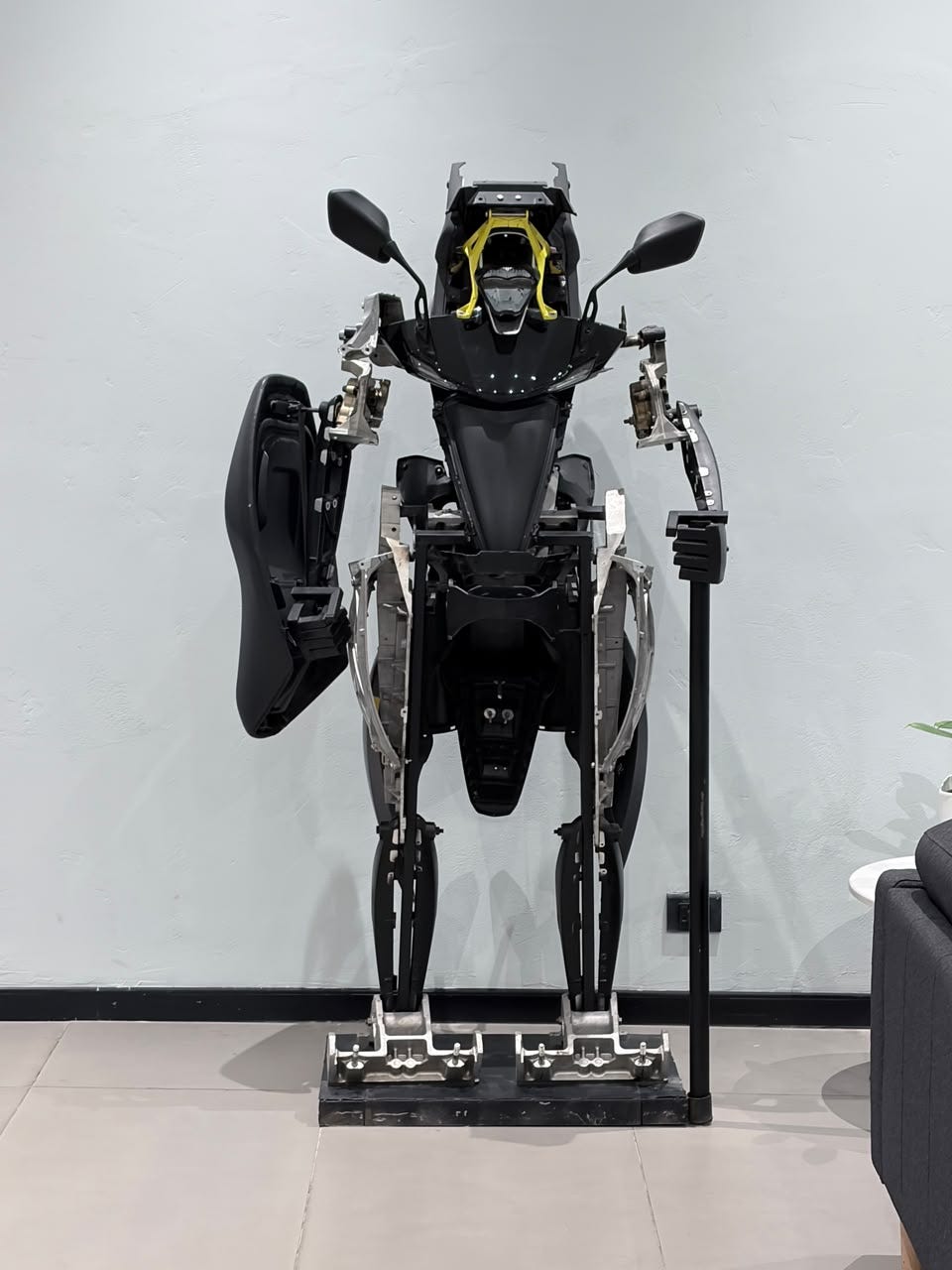
Here are a few moments from behind the scenes: