
 Newsletter
Last week, Nvidia made an announcement that could quietly reshape how the AI industry evolves. At its GTC 2026 event, the company introduced the Nemotron Coalition, a collaboration that brings together some of the most serious players in artificial intelligence today. The list includes global names like Mistral AI, Perplexity, LangChain, and Mira Murati’s Thinking Machines Lab.
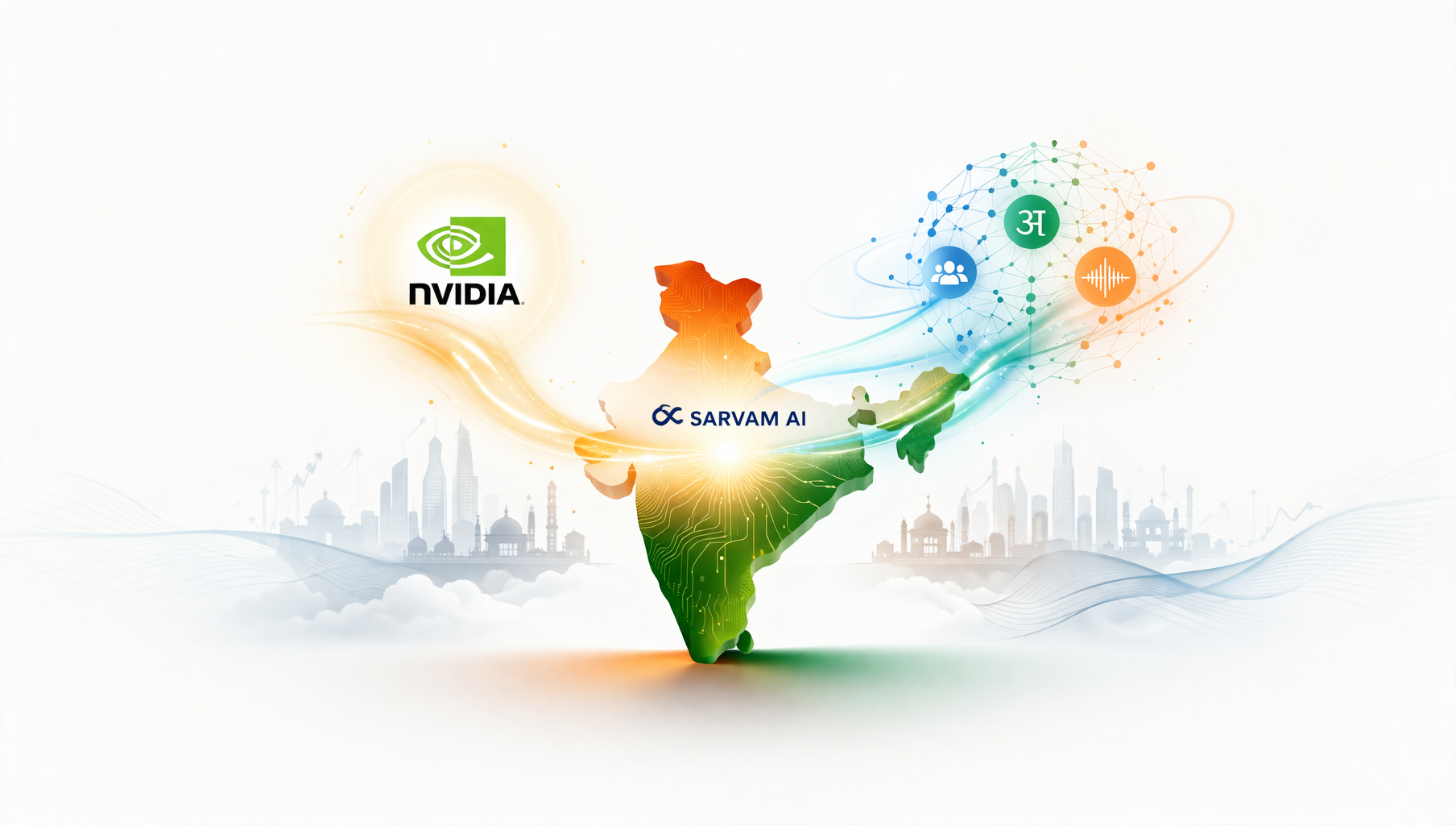
But what stood out, especially from an Indian lens, was the inclusion of Sarvam AI.
This may look like another industry partnership. Tech companies collaborate all the time. But this one signals a deeper shift in how AI might be built and distributed going forward.
To understand why this matters, it helps to look at how the AI ecosystem currently works.
Over the past few years, the space has been dominated by a handful of powerful, closed models. OpenAI’s GPT, Google’s Gemini, and Anthropic’s Claude have set the benchmark for what modern AI can do. These systems are incredibly capable, but they are also tightly controlled. Developers and businesses can access them through APIs, but they do not really get to modify the core models or adapt them deeply to their own needs.
This creates a dependency. If you are building an AI product today, you are likely building on top of someone else’s system, paying for access, and working within their constraints.
Nvidia’s Nemotron Coalition is trying to offer an alternative path. Instead of a few companies controlling the most advanced AI systems, the idea is to create powerful base models that are open and customisable. These models can then be adapted by companies, startups, or even governments for specific industries, languages, or regions.
The first step in this direction is already underway. Nvidia has worked with Mistral to develop a base model trained on its DGX Cloud infrastructure. This is not positioned as a finished product for end users. Instead, it is a foundation that others can build on. A bank could fine-tune it for financial use cases. A healthcare company could adapt it for diagnostics or patient support. A startup in India could train it further for local languages and voice-based interactions.
This approach lowers the barrier to entry in a meaningful way. Building a frontier-level AI model from scratch requires enormous resources. It involves access to massive datasets, thousands of high-performance GPUs, and years of research. For most organisations, this is simply not feasible. But starting from a strong base model and customising it is far more practical.
Nvidia is not just experimenting with this idea. Reports suggest the company plans to invest around $26 billion over the next five years into developing open-weight AI models. That level of investment signals long-term intent.
What makes this even more interesting is that Nvidia is not limiting itself to models. It is building an entire ecosystem around them. Alongside Nemotron, the company has introduced tools and infrastructure layers that support the full lifecycle of AI development. There is DGX Cloud for compute, frameworks like NeMo and AI-Q for building and deploying AI agents, and runtime systems that help manage how these models operate in real-world environments.
In effect, Nvidia is trying to position itself as the foundational layer of the AI economy. While other companies compete to build the best applications, Nvidia is focusing on the infrastructure that enables those applications to exist.
This strategy is not new in the broader history of technology. The companies that control the underlying platforms often end up shaping the entire ecosystem. In the smartphone world, operating systems like Android became more influential than individual apps. Nvidia appears to be taking a similar approach with AI.
There is also a broader industry shift happening in parallel. The debate between open and closed AI models is becoming more pronounced. Closed systems offer control, safety, and consistent performance, but they limit flexibility. Open models, on the other hand, allow greater experimentation and customisation, but they also come with challenges around safety and governance.
Meta has already pushed the open model approach with its Llama series. Mistral has built its identity around openness. Now Nvidia is amplifying this movement by providing not just models but the infrastructure needed to scale them.
This is where the concept of “sovereign AI” starts to come into play. Countries are beginning to see AI as critical infrastructure rather than just a technological tool. Just as nations invest in energy security or telecom networks, there is a growing push to develop AI systems that are locally controlled, culturally relevant, and aligned with national priorities.
Relying entirely on foreign AI systems raises concerns around data privacy, regulatory control, and long-term dependence. As a result, governments and companies are increasingly interested in building their own AI capabilities.
India is a strong example of why this matters. The country’s digital ecosystem is large and growing rapidly, with over 800 million internet users. But it is also highly diverse. There are more than 20 official languages and hundreds of dialects. A significant portion of the population interacts with the internet in non-English languages, often through voice rather than text.
Global AI models, which are predominantly trained on English data, do not always perform well in this context. They struggle with local nuances, regional languages, and cultural references. This creates a gap between what AI can do globally and what it can do effectively in India.
This gap is precisely where companies like Sarvam AI are focusing their efforts. Sarvam is working on building models that are optimised for Indian languages and voice-first use cases. Nvidia has already collaborated with Sarvam on large-scale models ranging from 3 billion to 100 billion parameters, tailored for local applications.
The inclusion of Sarvam in the Nemotron Coalition signals that India is becoming an important part of the global AI conversation. It is gradually becoming a place where they are built and adapted.
Localised AI models could improve access to digital services in rural areas, enable better customer support in regional languages, and support industries that rely on contextual understanding of local markets. For example, voice-based AI could help farmers access crop information, assist small businesses with inventory management, or simplify interactions with government services.
From a market perspective, the opportunity is substantial. India’s AI market is expected to grow to over $17 billion by 2027, with a compound annual growth rate exceeding 25%. Globally, the generative AI market is projected to cross $1 trillion over the next decade. Much of this growth is likely to come from specialised, industry-specific applications rather than general-purpose chatbots.
However, the open model approach is not without its challenges. Making powerful AI systems widely accessible raises questions about misuse, security, and quality control. Ensuring that these models are safe, reliable, and free from harmful biases is a complex task.
There is also the issue of performance. Closed models currently have an edge in terms of optimisation and consistency, partly because they are tightly controlled and continuously updated by a single entity. Open models depend on how well they are fine-tuned and deployed by different users, which can lead to variability in outcomes.
Despite these challenges, the gap between open and closed systems is narrowing. Improvements in training techniques, better tooling, and increased collaboration are making open models more competitive.
For Nvidia, this is also a strategic move to expand its role in the AI ecosystem. The company has already benefited from the surge in demand for GPUs, which are essential for training and running AI models. By moving into the software and platform layer, Nvidia is positioning itself to capture value beyond hardware.
If this strategy works, Nvidia could become a central player in how AI is built and deployed worldwide. Not just as a supplier of chips, but as the provider of the underlying infrastructure that powers a wide range of AI systems.
For India, the implications are equally important. Being part of this ecosystem provides access to advanced tools, global collaboration, and the opportunity to build AI systems that are tailored to local needs. It also aligns with broader national initiatives like Bhashini and private efforts like Krutrim, which aim to develop AI capabilities rooted in Indian languages and contexts.
The larger takeaway is that the AI industry may be entering a new phase. The initial wave was about proving what AI could do. The current phase is about scaling those capabilities. The next phase could be about distribution, making AI more accessible, adaptable, and relevant across different regions and use cases.