
 Newsletter

India's private equity firms have a slightly unusual problem right now.
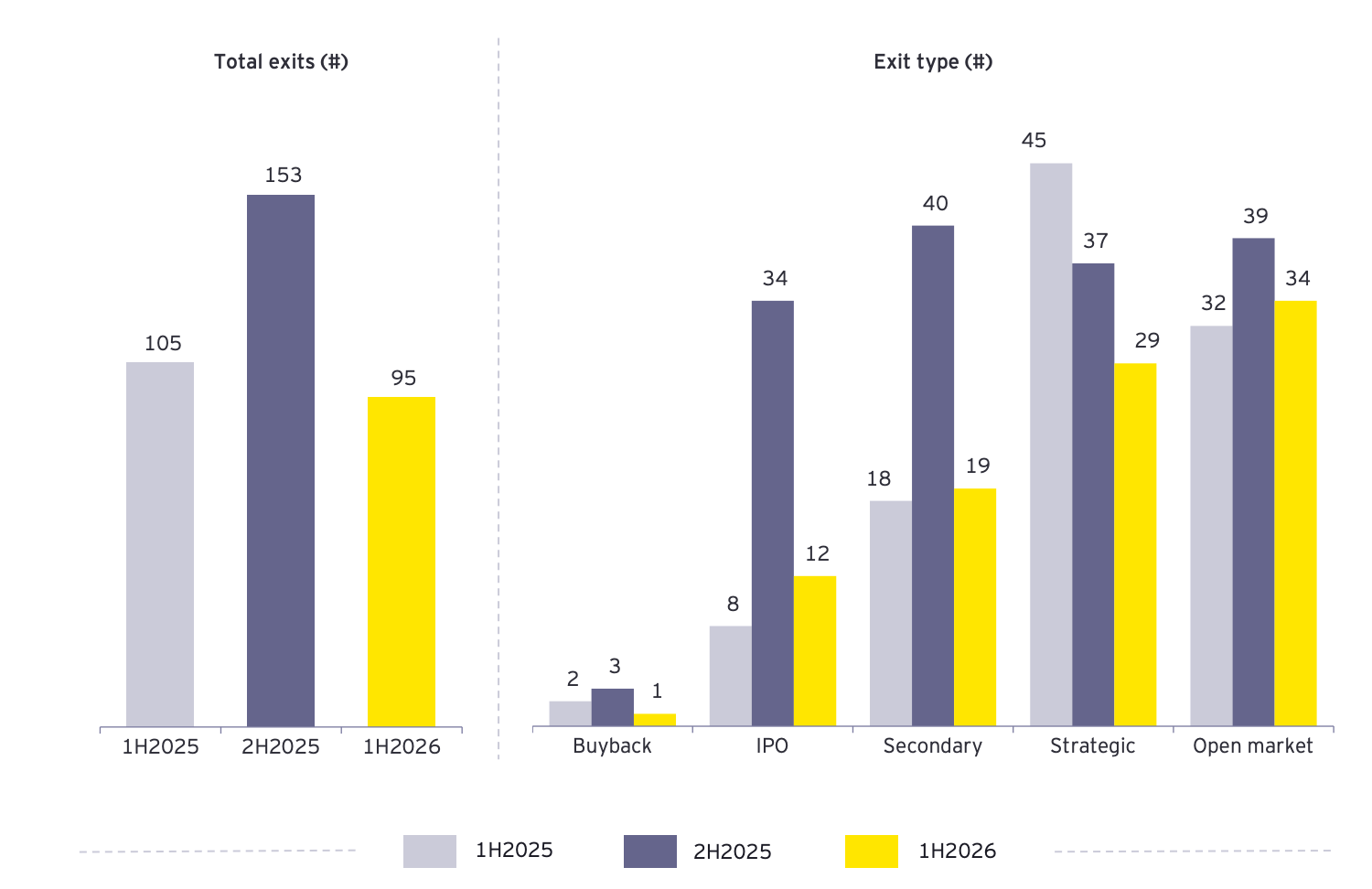
They spent years buying stakes in Indian companies, but selling those stakes and returning the money to their investors is getting harder. In the first half of 2026, PE and venture capital investors made exits worth $9.4 billion in India, down 29% from a year earlier.
The biggest hit came from IPO exits, where the value fell 47% to just $801 million across 12 deals, according to EY-IVCA data.
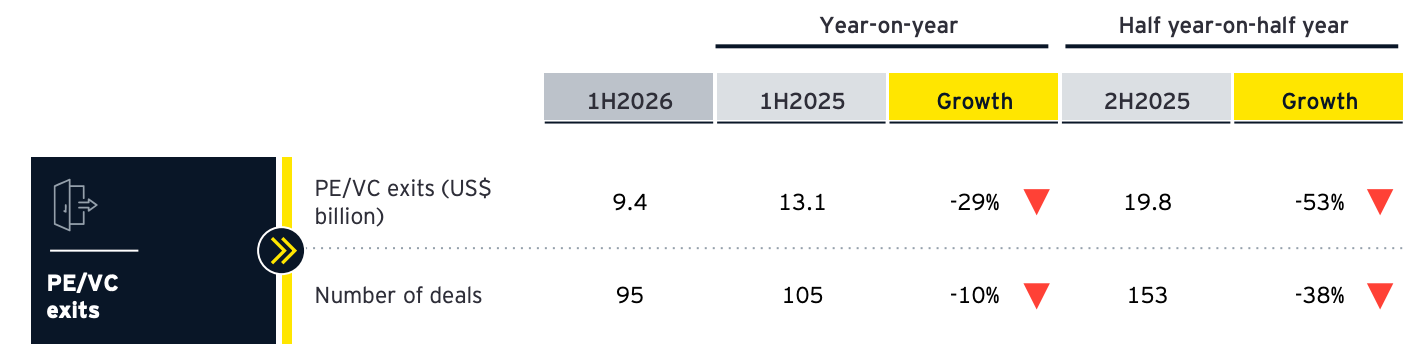
Image Source: EY
So even as India's IPO market begins to regain momentum, many PE firms are looking beyond the stock exchange and finding other buyers for companies they have held for years.
A large number of PE investments made between 2016 and 2021 are now approaching the stage where investors expect an exit. A private equity fund does not simply raise money and hold companies indefinitely. It collects capital from investors such as pension funds, sovereign wealth funds, family offices and institutions, invests that money into businesses and usually works within a fund life of around 10 years, although extensions are possible.
Somewhere along the way, those businesses have to be sold so the fund can return actual cash to the people who originally gave it the money. With many investments now five to 10 years old, that pressure is becoming harder to ignore.
In the industry, this is tracked through DPI, or distributed-to-paid-in capital, which simply measures how much money a fund has actually returned to its investors compared with how much they invested.
A portfolio may look fantastic on paper and the fund may claim that its ₹100 investment is now worth ₹200, but that valuation does not pay investors until the asset is sold. So if IPOs get delayed, the problem is not just that a PE firm has to wait longer to sell. It also has to wait longer to return money to its own investors.
Normally, an IPO can solve this problem. A PE-backed company lists on the stock exchange, the investor gradually sells its shares and the money goes back to the fund. But IPOs depend heavily on market conditions, investor appetite and valuations.
A company can spend months preparing for a listing and still postpone it because markets turn volatile or public investors refuse to pay the expected price. Even after listing, existing shareholders may face restrictions on immediately selling their entire holding. For a PE fund approaching the end of its life, waiting another year for the perfect IPO window may simply not be attractive.

That is pushing more investors towards private transactions instead.
A good example arrived earlier this month when KKR agreed to acquire Medicover's Indian hospital operations in a deal worth about $1.3 billion. Medicover had previously been preparing its Indian business for an IPO, but the listing did not happen. Rather than wait indefinitely for public markets, the company found a private buyer willing to write a very large cheque.
This is creating a larger market for what the industry calls sponsor-to-sponsor transactions. It simply means one PE investor selling a business to another PE investor.
Suppose Fund A bought a company when it generated ₹500 crore in revenue, helped expand it and now wants to exit when revenue reaches ₹2,000 crore. Fund B may still see room to take the same company to ₹5,000 crore. Fund A gets its cash back, Fund B gets an established business with further growth potential and the company avoids depending entirely on an IPO.
In H1 2026, secondary transactions in India accounted for about $1 billion across 19 deals, while open-market sales generated $4.1 billion and represented 44% of total PE/VC exit value.
There is an even more interesting option when a PE firm does not actually want to let go of a good company. It can use something called a continuation vehicle. Imagine a fund owns a fast-growing hospital chain that it bought several years ago.
The original fund is approaching the end of its life, so some investors want their money back, but the PE manager believes the hospital business could become substantially more valuable over the next five years.
Instead of selling it to a completely unrelated buyer, the manager can move the investment into a newly created fund. Existing investors can usually cash out or continue investing, while new investors provide the money needed to give those exiting investors liquidity.
In effect, the old fund gets an exit while the PE manager gets more time with the asset. India is already becoming relevant in this market. An analysis by Treelife found that India accounted for roughly 21% of completed continuation vehicles across emerging markets between 2020 and H1 2025.
This year, Morgan Stanley has reportedly been working on a proposed $500 million India-focused continuation vehicle that would house eight healthcare investments. If more ageing Indian PE portfolios contain businesses that managers still want to own, these structures could become increasingly common.
There is another number that makes this entire shift particularly interesting.
While exits are under pressure, money entering private markets has not disappeared. PE and VC funds announced or raised about $21.2 billion across 48 fundraises in H1 2026, according to EY-IVCA, compared with about $10.1 billion in H1 2025. So India's private equity market currently has an unusual mismatch.
New capital continues to arrive, but some of the older capital is struggling to leave. That creates an opportunity for secondary investors because they can provide liquidity to older funds while gaining access to businesses that have already spent years growing under institutional ownership.
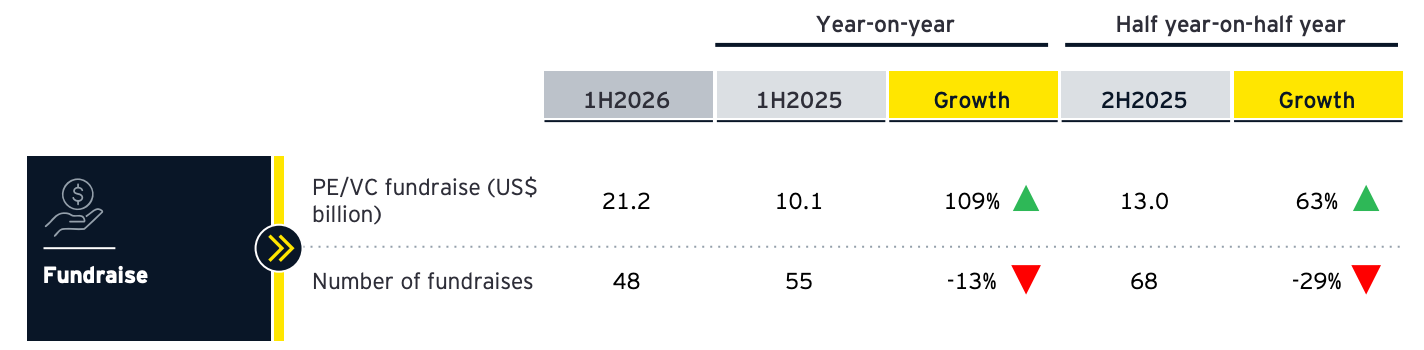
Image Source: EY
Regulatory changes are also making alternative exits more practical. Changes introduced in 2026 have altered the tax treatment and structuring of routes such as buybacks and secondary transfers, giving investors more options when designing exits. The broader point is not that IPOs are becoming irrelevant.
A strong company can still receive an attractive valuation from public markets, and an IPO remains one of the most important ways for PE investors to eventually sell their holdings. What is changing is the assumption that every attractive PE-backed company must patiently wait for the stock market before its investors can get liquidity.
These alternatives come with their own complications. A PE fund desperate to exit may have to accept a lower valuation from another private investor than it hoped to receive through an IPO.
Continuation vehicles create an even more obvious conflict because the same PE manager can effectively be involved on both sides of the transaction. If an asset moves from an old fund managed by the firm into a new fund also managed by it, deciding a fair price becomes critical.
Independent valuations, investor approvals and clear governance therefore matter because existing investors need confidence that the transaction is being done for their benefit rather than simply allowing the manager to hold a favourite asset for longer.
What is happening is ultimately a sign that India's private equity ecosystem is becoming more complex. For years, much of the conversation focused on how much global capital was entering India and which companies PE giants were buying. But a mature private market also needs efficient ways for that capital to eventually leave.
With $9.4 billion of exits in H1 2026 against $21.2 billion of announced or completed fundraising activity, that liquidity question is becoming increasingly difficult to ignore. IPOs will remain part of the answer, but sponsor-to-sponsor deals, secondary sales and continuation vehicles are giving investors more routes to the same destination.
India spent the last decade building a huge market for private capital to enter companies. The next phase may be about building an equally sophisticated market for getting that capital back out.