

 Newsletter
For years, India had a sugar problem that sounded almost absurd.
We produced too much of it.
When crops were good, mills ended up sitting on large inventories. Sugar prices weakened, mills struggled to generate cash, and payments to sugarcane farmers got delayed. The government needed a way to absorb some of that excess.
Ethanol became part of the answer.
Instead of turning every bit of sugarcane into sugar, mills could divert cane juice and molasses towards ethanol, which would then be blended with petrol. Farmers still had a buyer, mills got another source of revenue, and India could reduce some of its dependence on imported fuel.
Fast forward to August 2026, and the problem has flipped.
Sugar is suddenly expensive.
The all-India average retail price reached ₹64.24 a kg on 30 August, according to Consumer Affairs Ministry data cited by PTI. That is roughly 30% higher than a month earlier and nearly 39% higher than a year ago. In some markets, prices briefly moved towards ₹75-80 a kg.

Image credit: Navbharat times
India is now doing things usually associated with a shortage. It has allowed duty-free imports of 10 lakh tonnes of raw sugar, imposed limits on how much sugar traders and large industrial buyers can hold, started checking stocks at mills and asked factories to begin crushing cane earlier.
Quite a turn for one of the world’s largest sugar producers. The obvious explanation would be that India simply ran out of sugar.
Except it hasn’t.
The government still expects domestic production to be enough to cover annual consumption. The problem is that the cushion has become much thinner than expected.
At the beginning of the season, sugar output was estimated at roughly 343 lakh tonnes. That estimate has since fallen to around 306 lakh tonnes.
India consumes roughly 280-290 lakh tonnes of sugar a year. So the country still has enough in aggregate. But nearly 37 lakh tonnes of expected production has disappeared from the calculation.
Some of that came from problems in the fields.
Sugarcane crops in parts of the country were hit by diseases such as Red Rot and Top Borer, while excessive rainfall and waterlogging damaged crops elsewhere, according to the Food and Public Distribution Department.
And India entered August in an awkward part of the sugar calendar.
The previous crushing season was largely over. The next one would only begin properly around October. Meanwhile, Ganesh Chaturthi, Navratri, Dussehra and Diwali were approaching.
That means mithai makers, beverage companies, bakeries, food manufacturers and traders were all preparing for one of their busiest periods before a fresh wave of sugar had started entering the market.
A lower crop plus higher seasonal demand is enough to make people nervous about future supply.
And nervous markets behave differently.
A trader who normally keeps two weeks of inventory may decide to keep three. A sweets manufacturer may buy early rather than risk paying more before Diwali. A distributor sitting on stock may delay selling because prices are rising every few days.
Nobody has to believe that India will literally run out of sugar. They only have to believe that sugar will be more expensive tomorrow.
Once enough buyers start behaving like that, sugar that technically exists stops reaching the market at the usual pace.

Image Credit: filmycrumbs18
The Centre had already noticed something odd by late July. On 28 July, it said rising ex-mill prices were not fully supported by the underlying demand and supply situation.
In other words, the crop was weaker, but prices appeared to be running ahead of the actual shortage.
The sugar industry itself has since pointed towards speculative stocking and hoarding by traders and bulk consumers. Maharashtra minister Hasan Mushrif has gone further, alleging that weak enforcement and excess releases by some mills helped fuel an artificial rise.
Dealers are now subject to stock limits. Large industrial users will generally be restricted to around 15 days of consumption. Government teams have been checking mill inventories. And instead of allowing sugar to trickle into the market over a longer period, the Centre has moved towards tighter release windows.
For the first half of September alone, mills have been given a quota of 13 lakh tonnes.
The intention is fairly clear: get sugar out of storage and into the market faster. There is already some evidence that this is working further up the chain. After the government announced additional supply measures, ex-mill prices fell sharply, by roughly 20% according to government figures.
Retail prices, however, remained above ₹60 a kg in many cities.
That gap is worth watching.
Sugar does not travel directly from a mill to your kitchen. It moves through wholesalers, distributors and retailers, many of whom may already be carrying stock purchased at higher prices. So some delay between a fall in mill prices and a fall at the kirana store is normal.
But the longer retail prices remain high while mill prices decline, the more attention shifts towards margins and inventory sitting between the two.
Then comes the politically messier part of the story: ethanol.
As sugar became expensive, critics began asking whether India had diverted too much sugarcane towards fuel. The argument is easy to understand. If sugar costs ₹60-plus a kilo, why should cane be going into petrol tanks?
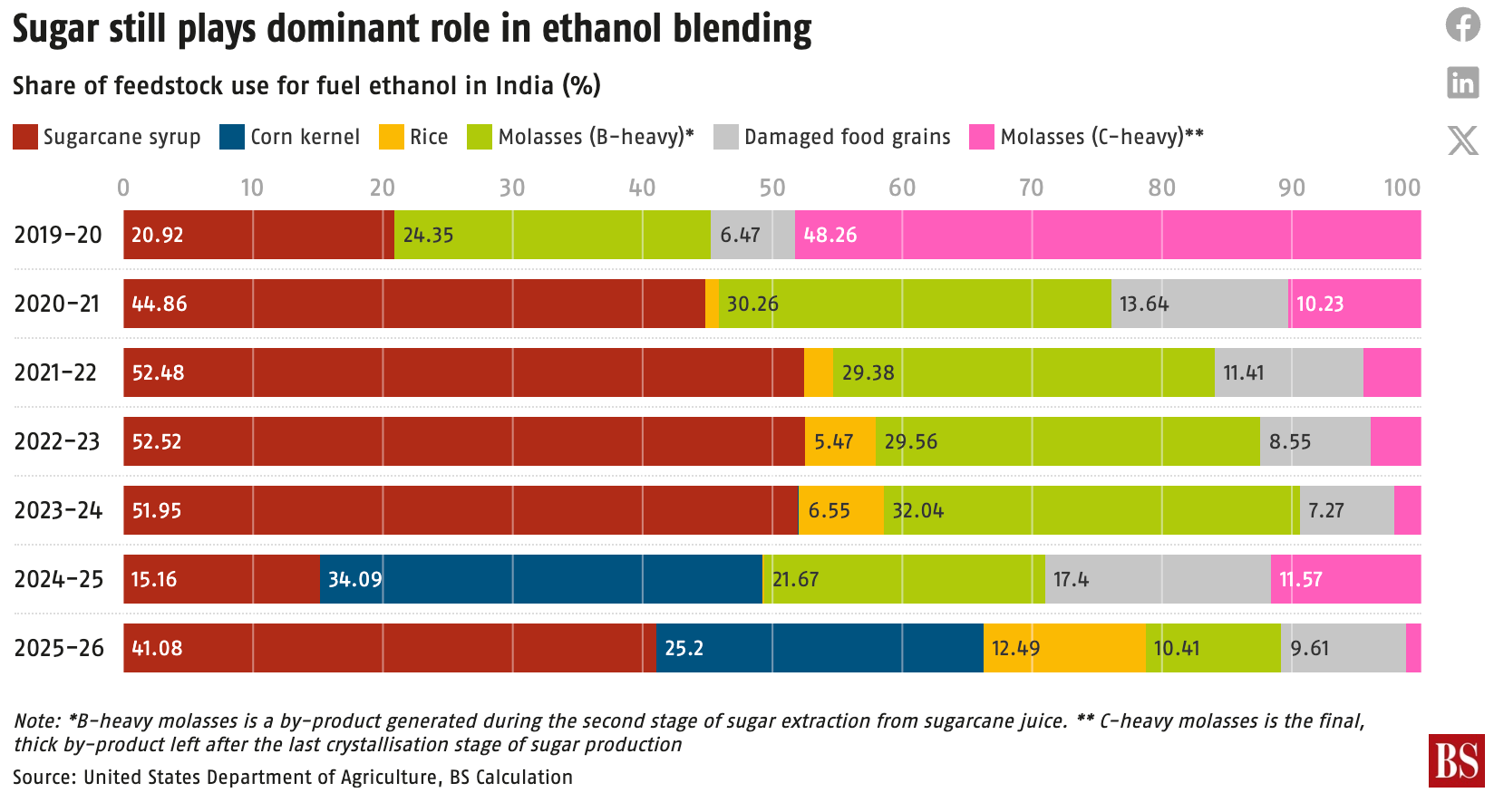
Image Credit: Business Standard
But the current data makes ethanol a weak explanation for the entire August spike.
The government says the share of sugar diverted towards ethanol has actually fallen from about 12% in 2022-23 to roughly 9% this season. India’s ethanol programme has also become far less dependent on sugarcane than it once was, with grains now supplying the majority of ethanol production.
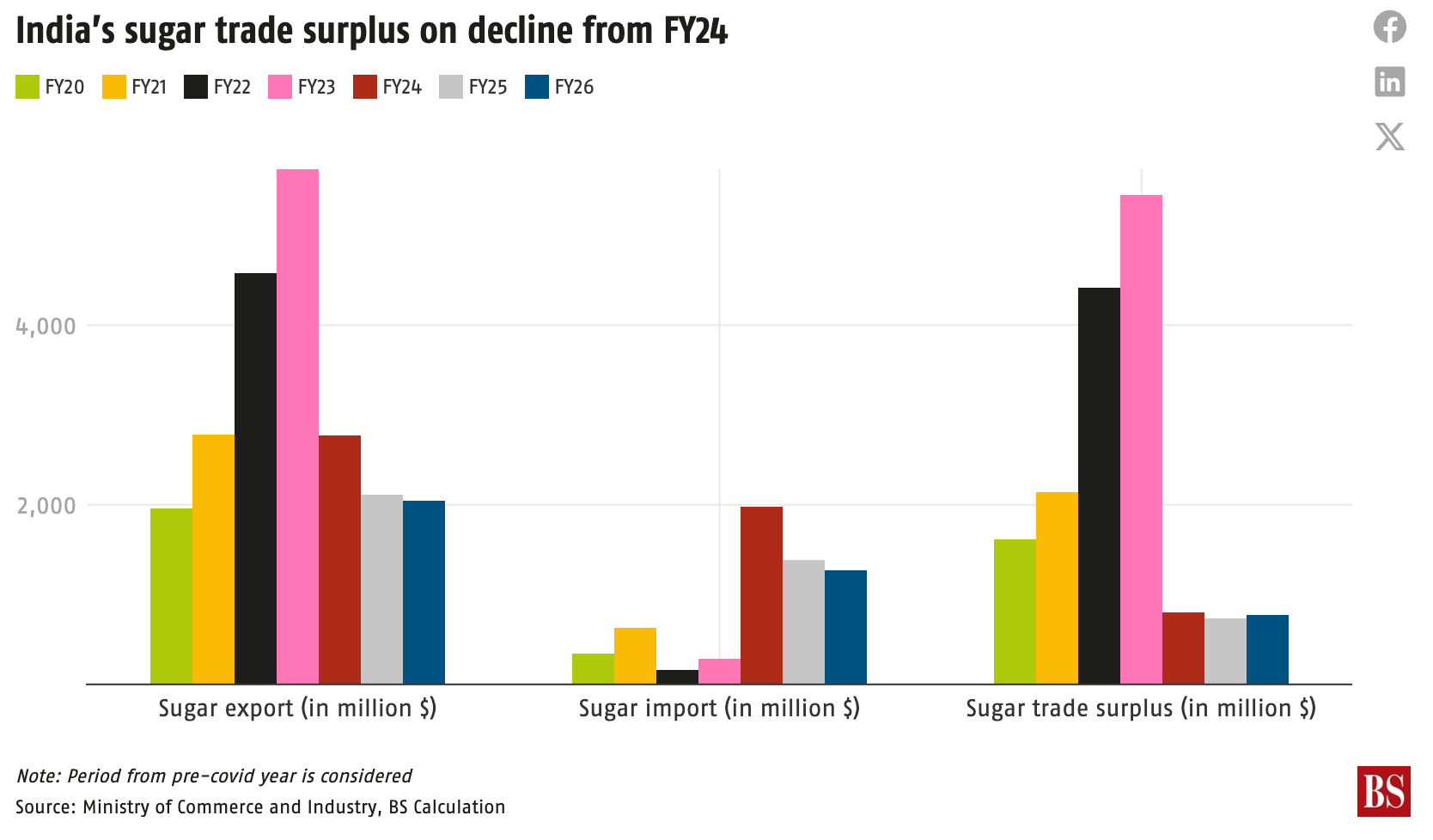
Image Credit: Business Standard
So ethanol has not suddenly swallowed India’s sugar supply.
The ethanol policy was built during years when India regularly had excess sugar. Diverting cane helped prevent gluts and gave mills a steadier source of income. When the surplus shrinks, that same system becomes harder to manage.
The government has to balance three groups at once.
Consumers want affordable sugar. Mills and farmers need cane prices high enough to keep production viable. And the energy system wants enough ethanol to meet India’s blending targets.
A bumper crop makes those interests easier to reconcile. A weak crop forces trade-offs.
Global markets are not offering much relief either.
International sugar prices rose from around $474 a tonne at the end of June to about $552 by 20 August. The government also expects a global sugar deficit in 2026-27.
That means importing sugar, the easiest way to calm a domestic shortage, has become costlier too.
India has still chosen to do it.
The Centre has permitted 10 lakh tonnes of raw sugar to enter duty-free and is pushing mills to start the next crushing season from 15 October. An earlier start could lift October production from the usual 3-4 lakh tonnes to more than 10 lakh tonnes, according to government estimates.
Which brings the story back to where it began.
India does have sugar.
It just has far less room for error than it did a year ago. The next few weeks should make the picture clearer.
If imports arrive, mills release more stock and October crushing pushes retail prices down quickly, August will look like a temporary squeeze made worse by aggressive stocking. If sugar stays expensive even after fresh production begins, India may have a more uncomfortable problem to deal with.