

 Newsletter

If you think India mainly exports cotton shirts, spices and shiny diamonds, you are stuck in a 1990s. The export story of India in 2025 looked very different, and it quietly tells you how the country’s economy has grown up over the last two decades.
Exports are not just about trade numbers. They decide how many factories run at full capacity, how many jobs get created, how strong the rupee stays, and how seriously the world takes India as a manufacturing and economic power.
Over the past year, India’s total exports of goods and services crossed the $800 billion mark. That is not a small number for a country that once struggled with foreign exchange shortages. But the real story is not the total value. It is what India is exporting and how that mix has changed.
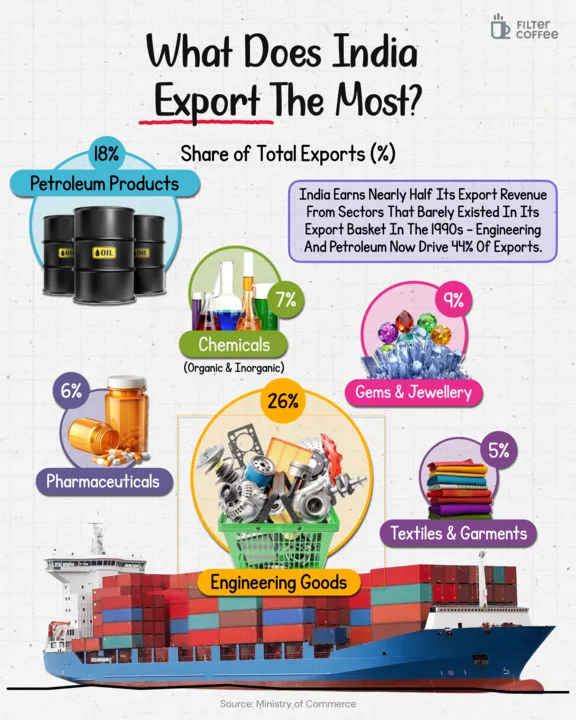
At the top of the list today are engineering goods. This category alone contributes roughly a quarter of India’s merchandise exports. We are talking about machinery, industrial equipment, auto components, transport equipment, electrical goods and metal products.
These are not low skill, low value items. They require design capability, precision manufacturing, quality control and long term buyer relationships. The fact that engineering goods are now India’s biggest export segment tells you that Indian factories are part of global supply chains that demand consistency and reliability.
Right behind engineering goods are petroleum products. India imports crude oil, refines it, and exports high value fuels and petro products to other countries. This segment’s share moves up and down depending on global oil prices, but it consistently remains one of the top contributors.
Together, engineering goods and petroleum products account for close to half of India’s export earnings. That is a huge shift from the past, when exports were dominated by raw materials and basic consumer goods.
Then comes a cluster of sectors that give India’s export basket depth and resilience. Pharmaceuticals are a big one. India has earned its reputation as the pharmacy of the world by supplying affordable generic medicines to both developed and developing markets. This sector may not always grab eyeballs, but it quietly brings in steady foreign earnings year after year.
Chemicals, both organic and inorganic, are another important pillar. These are inputs for everything from agriculture to manufacturing to consumer goods. As global supply chains look for alternatives outside China, Indian chemical manufacturers have found themselves in a sweet spot.
Gems and jewellery still play a role, though their share is smaller than what many people assume. This sector is highly sensitive to global demand cycles, tariffs and consumer sentiment, especially in markets like the United States. When times are good, exports shine. When uncertainty hits, volumes dip quickly. That volatility is one reason why India has been trying to reduce overdependence on this segment.
Textiles and garments, once the backbone of Indian exports, now form a relatively modest share. The sector still employs millions and remains important socially and politically, but globally it faces intense competition from countries with lower costs or trade advantages. The decline in its share does not mean textiles are failing. It simply means other sectors have grown much faster.
What makes this export mix interesting is what it says about India’s economic direction. Higher value manufacturing exports tend to create better paying jobs and stronger industrial ecosystems. They also make an economy less vulnerable to commodity price swings. When you export machinery instead of raw cotton, you capture more value within the country.
There is also a geographic angle to this story. The United States remains India’s single largest export destination, but it is no longer the only pillar. The Middle East, parts of Europe and several Asian economies now form a growing share of India’s export markets. This diversification matters because it reduces the risk of one country’s policy changes or slowdown derailing the entire export engine.
Of course, the journey is not smooth. Global trade is becoming more protectionist. Tariffs, supply chain disruptions and geopolitical tensions constantly test exporters. Some sectors, like textiles and jewellery, feel the pain faster than others. But the broader trend is clear. India’s export basket is wider, more sophisticated and more balanced than it has ever been.
Zoom Out: India is no longer just exporting what it has. It is exporting what it can make well. Engineering goods, refined fuels, pharmaceuticals and chemicals are not accidental successes. They are the result of years of capacity building, policy nudges, private investment and firms learning how to compete globally.
It also gives India more leverage in global trade conversations.
And that shift is one of the clearest signs that India’s economy is maturing, step by step, shipment by shipment.