
 Newsletter
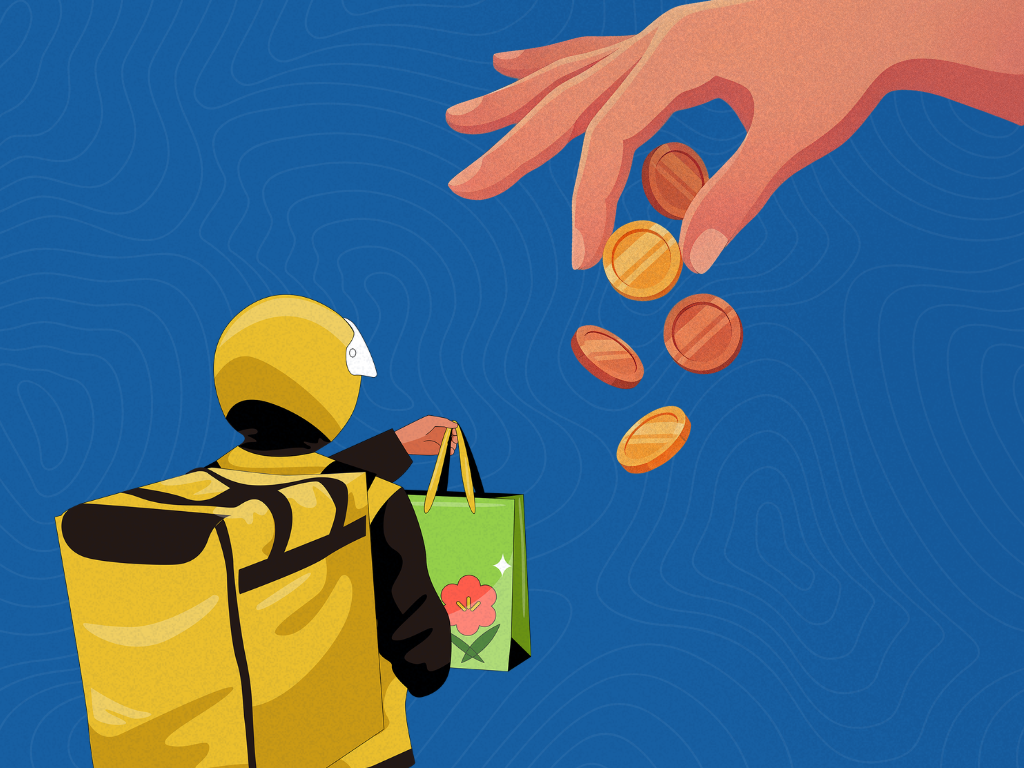
India just quietly added millions of jobs without opening a single office.
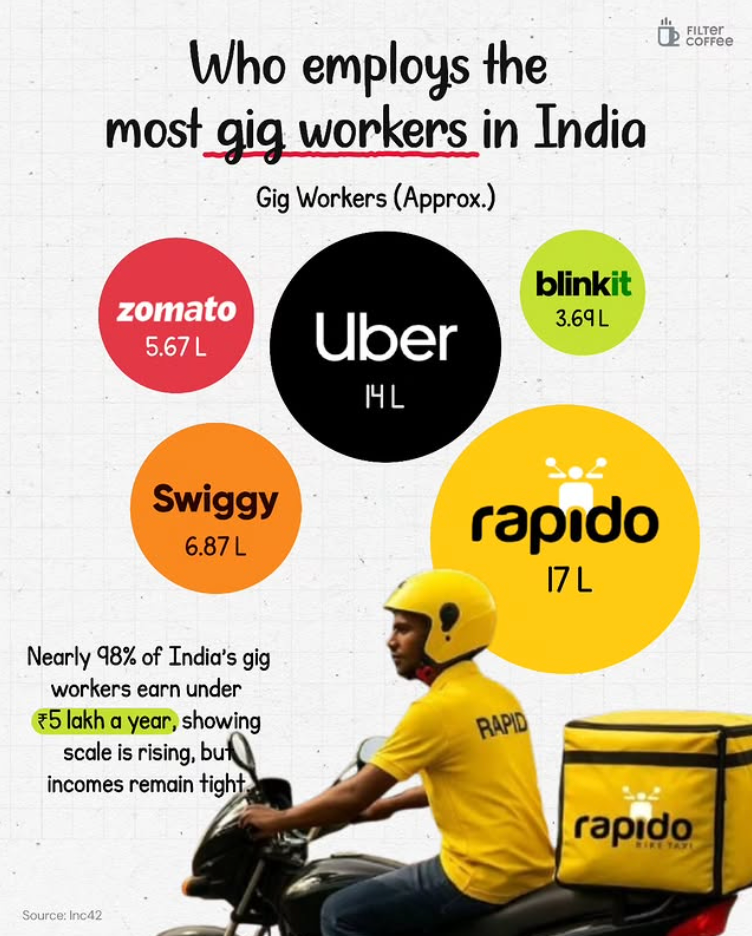
Platforms like Rapido, Uber, Swiggy and Zomato are now among the largest employers in the country, each running fleets of workers that rival traditional industries. Rapido alone is estimated to have around 17 lakh gig workers. Uber comes close with about 14 lakh.
Swiggy and Zomato together add another 12 lakh plus. Blinkit is catching up too. Add it all up and you start seeing the real picture. India’s gig workforce is no longer a side story. It is becoming the backbone of urban employment.
But here’s the catch. Nearly 98% of these workers earn under ₹5 lakh a year.
So while the top line looks massive, the bottom line for workers still feels… tight.
This gap didn’t happen overnight. It was built into the model. Platforms are designed for scale first. They reduce entry barriers, onboard lakhs of workers quickly, and create supply that matches rising demand for convenience. Food arrives in 20 minutes. Autos show up in 3. Groceries reach before you even finish your chai. Behind this convenience is a constantly rotating pool of workers optimising for time, distance, and incentives.
And that scale is only getting bigger. India had around 77 lakh gig workers in 2021. By 2025, that number has already crossed 1.2 crore. Government estimates suggest this could hit 2.35 crore by 2030. That is nearly the size of Australia’s entire workforce, just working through apps.
What’s driving this? Three things. Cheap smartphones, affordable internet, and a growing urban demand for convenience. Add to that a workforce that is young, flexible, and often struggling to find stable formal jobs. Gig work becomes the easiest entry point. No degree needed. No interviews. Just download an app and start earning.
But that ease comes with trade-offs.
Income volatility is one. A worker’s earnings depend on demand, incentives, fuel prices, and even algorithm changes. There is no fixed salary, no paid leave, and until recently, almost no social security. If the app logs you out, your income stops. Simple as that.
This is exactly why the next phase of India’s gig economy is not about growth. It is about structure.
The government has started stepping in. In Budget 2025, it announced that gig workers will be registered on the e-Shram portal and given identity cards. Around 1 crore workers are expected to get access to healthcare under Ayushman Bharat. This is the first serious attempt to treat gig workers like part of the formal workforce.
States are moving too. Karnataka has introduced a law to create a welfare board for gig workers, set up a welfare fund, and bring in rules around transparency in how platforms manage workers through algorithms. That last part matters more than it sounds. For most gig workers, the app is the boss. And the boss never explains its decisions.
But regulation is not friction-free. Industry bodies have already pushed back, asking for clarity on how welfare fees will be calculated and who will bear the cost. Because if platforms absorb it, margins get hit. If customers pay, prices go up. And if workers pay, well… that defeats the whole purpose.
Meanwhile, the companies are still expanding aggressively. Rapido is aiming to cross ₹1,000 crore in revenue and expand to 500 cities. Quick commerce players are opening more dark stores. Food delivery platforms are pushing subscriptions and faster deliveries. The engine is still running at full speed.
So where does this leave us?
India’s gig economy is entering its most important phase yet. The first phase was about proving that scale is possible. That part is done. The second phase is about making that scale sustainable.
Can platforms continue to grow while improving worker incomes? Can regulations protect workers without killing the flexibility that makes gig work attractive? And can this model evolve from “just enough earnings” to “actually stable livelihoods”?
Right now, India is somewhere in the middle of that transition.
The apps are booming. The workers are showing up. The government is stepping in.
Now comes the harder part. Making the system work for everyone.