

 Newsletter

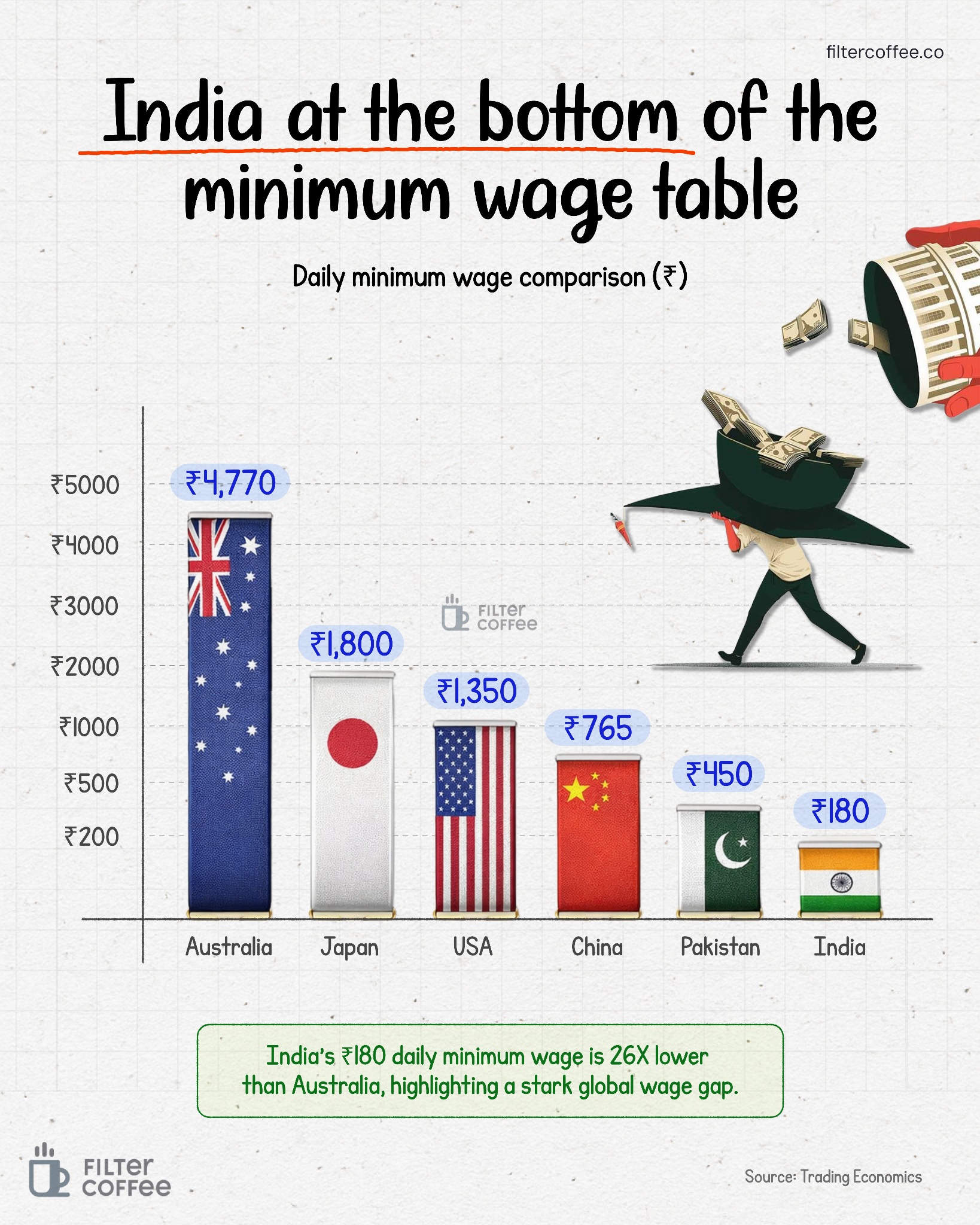
India is often described as one of the world’s most cost competitive labour markets. The comparison becomes striking when you look at minimum wages across countries. In Australia, the equivalent daily minimum wage can cross ₹4,700. In Japan it is around ₹1,800. In the United States it is roughly ₹1,350. In India, the benchmark floor wage works out to about ₹180 a day.
That means a worker in Australia can earn in a single day what might take several days for a worker in India. Technically, the gap looks enormous. But reducing India’s wage story to a single comparison misses a much bigger and more complex reality.
For starters, India doesn’t actually have one universal minimum wage that applies to everyone. Unlike countries where national wage floors are clearly defined, India’s labour system is layered. Minimum wages vary across states, industries, and skill levels.
A construction worker in Maharashtra, for instance, may earn a very different statutory minimum wage compared to a textile worker in Tamil Nadu or a security guard in Delhi. The central government does publish a “floor wage”, which acts as a benchmark, but states are free to set their own minimum wages as long as they remain above that floor.
This complexity comes from the structure of India’s labour market itself. According to government data, India has one of the largest workforces in the world, with labour force participation touching about 60% for people aged 15 and above.
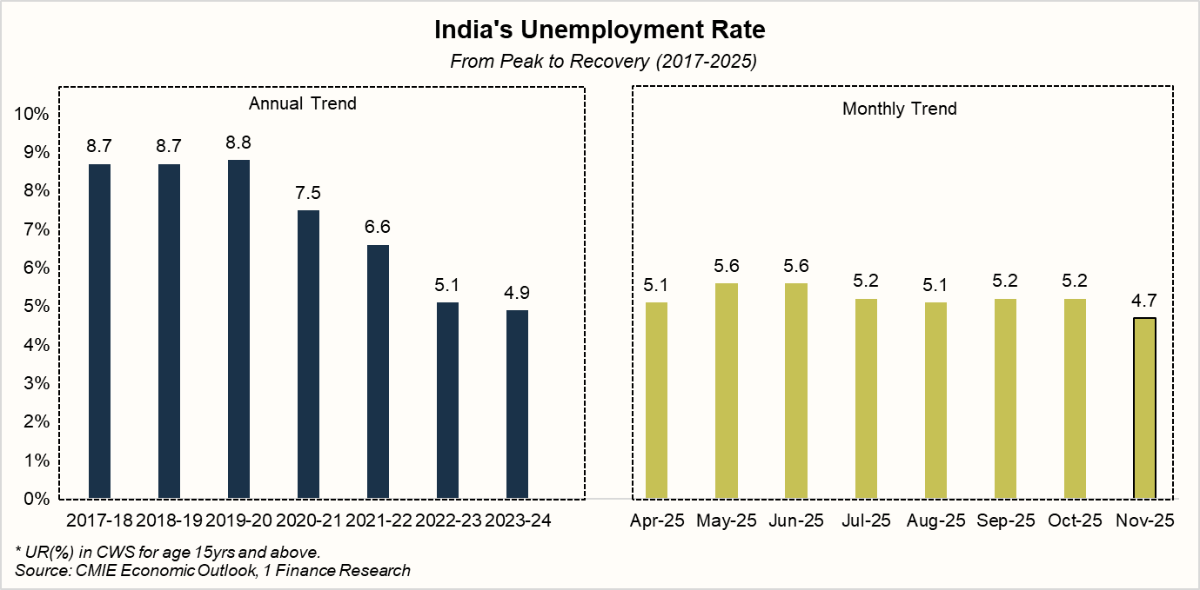
The unemployment rate has dropped to roughly 3.2% in recent surveys. At the same time, the nature of work in India is very different from developed economies. A large portion of workers are employed in the informal sector.
Estimates suggest nearly 80-90% of India’s workforce operates outside formal payroll systems. These workers often earn daily wages that are influenced more by local demand and supply conditions than by official minimum wage notifications.
And yet, this wage structure has also been one of India’s biggest economic advantages.
Lower labour costs have long made India attractive for outsourcing, manufacturing, and services exports. Global IT and business process outsourcing industries grew rapidly in India partly because companies could hire skilled workers at a fraction of Western wage costs. The same cost advantage is now drawing global manufacturers looking to diversify supply chains away from China.
But there is a catch. Cheap labour alone does not automatically translate into economic prosperity. Economists often point out that what matters more than wages is productivity. If workers produce more value per hour, companies can afford to pay higher salaries while remaining competitive. Countries like Japan and the United States have far higher wages because productivity levels are also much higher.
India has been trying to address this gap through labour reforms. The government consolidated 29 labour laws into four labour codes, including the Code on Wages. These reforms aim to standardize wage regulations, simplify compliance, and expand minimum wage coverage to more workers across sectors. The idea is to bring more clarity to wage structures while also encouraging formal employment.
Another major shift is the gradual formalisation of India’s workforce. Platforms like e-Shram have registered over 31 crore informal workers, giving policymakers better visibility into segments that previously operated completely outside formal systems. Payroll data from schemes like EPFO and ESI also indicates that millions of workers are slowly entering formal social security systems each year.
Meanwhile, new forms of work are emerging. The gig economy, led by companies in ride-hailing, food delivery, logistics, and digital services, is creating a different kind of wage discussion. Platform workers often fall somewhere between traditional employment and independent contracting, raising new questions about minimum wage protections, social security benefits, and income stability.
All of this means India’s wage story is evolving. On paper, wages may still look extremely low compared to advanced economies. But the bigger question is whether India can gradually move from being a low wage economy to a high productivity one. Rising productivity could push wages upward without eroding India’s competitiveness.
For now, the wage gap remains real. A worker in Australia can earn in a day what many Indian workers might earn in a week or more. But India’s challenge isn’t simply to raise wages overnight. The real challenge is creating millions of productive jobs, improving worker skills, expanding formal employment, and building industries that generate higher value.
If that happens, India’s wage story in the coming decades may not just be about being the world’s cheapest workforce. It could eventually become a story about how a massive workforce slowly moved up the value chain and changed the economics of labour altogether.