

 Newsletter

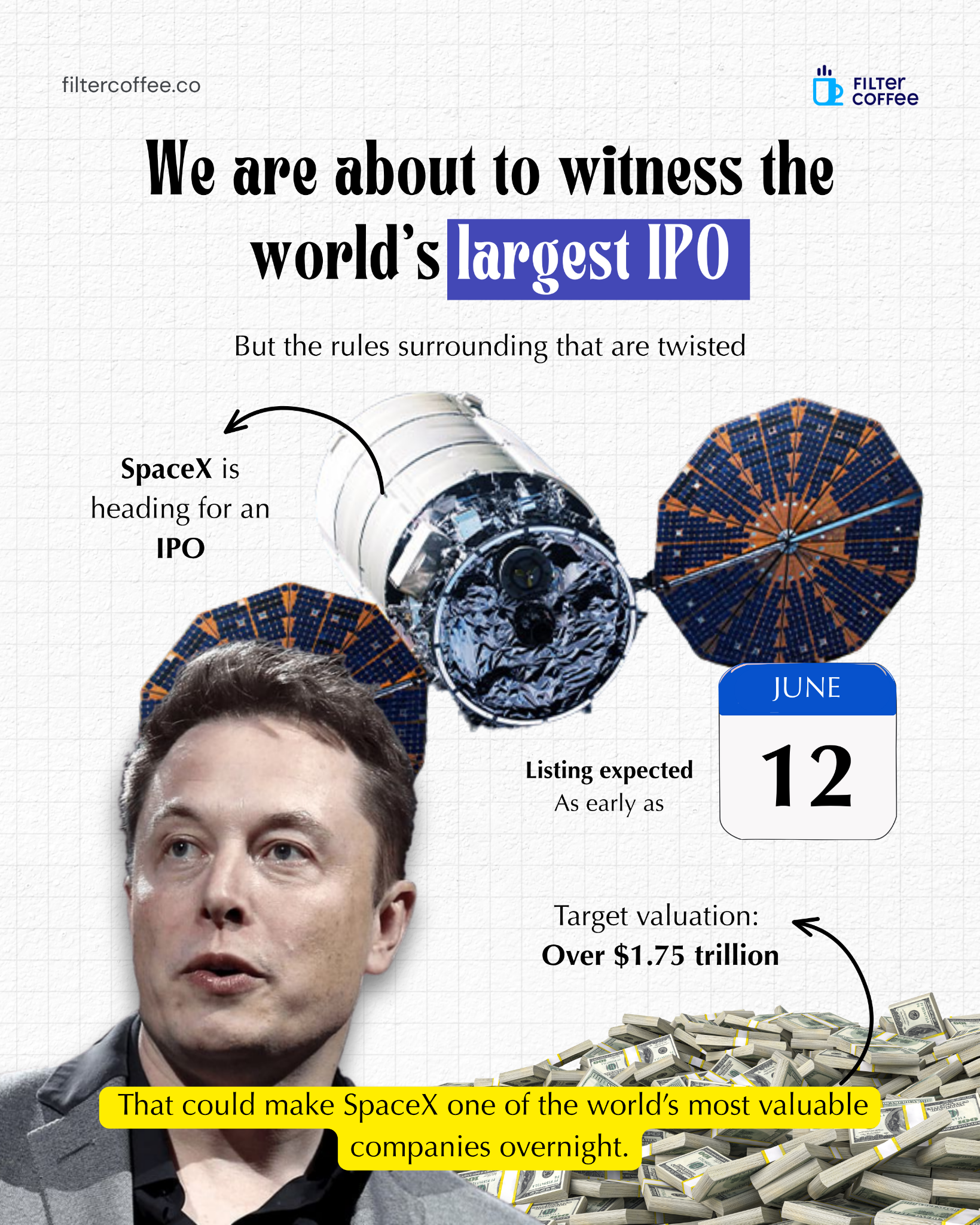
SpaceX is reportedly racing toward a blockbuster IPO that could value the company at nearly $1.75 trillion, potentially making it one of the biggest public listings the world has ever seen.
For comparison, India’s most valuable listed company Reliance Industries is worth roughly $240 billion. Even Saudi Aramco, one of the largest oil giants on Earth, debuted publicly at a valuation of about $1.7 trillion in 2019.
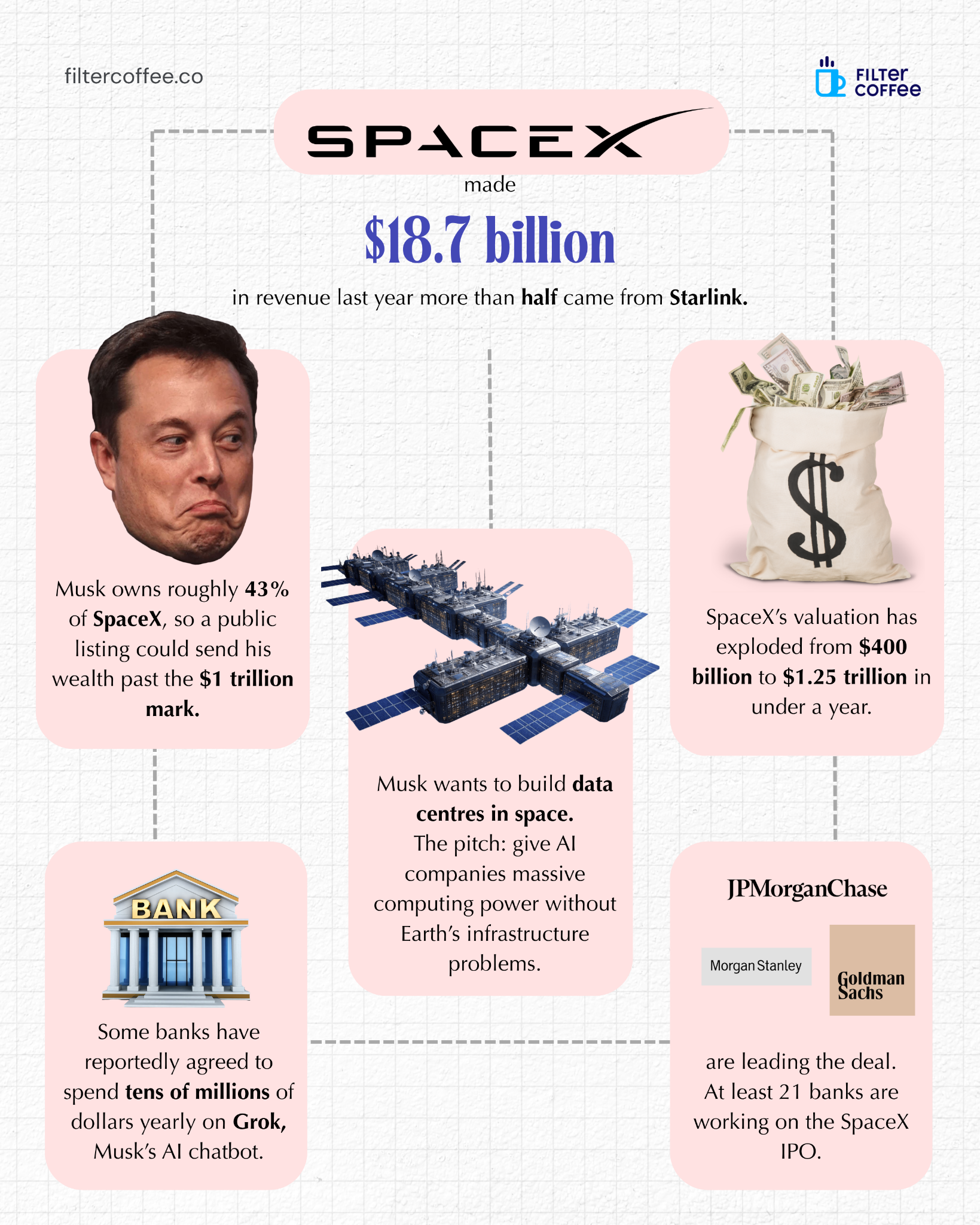
What makes this rise even more unbelievable is that SpaceX was valued at around $400 billion not too long ago, and private market estimates now place it above $1.2 trillion.
The real engine powering SpaceX today is Starlink, its satellite internet business that beams internet from thousands of satellites orbiting Earth is rapidly turning into a global telecom giant.
Today Starlink is already active in over 100 countries and has become one of the fastest-growing internet businesses globally. SpaceX generated around $18.7 billion in revenue last year and more than half of that came from Starlink alone.
Now SpaceX stopped looking like a risky aerospace company and started looking like a giant global telecom and infrastructure company.
And that changes the whole picture.
Because telecom businesses get valued very differently from rocket companies. They generate recurring monthly subscriptions, long-term customer contracts and stable cash flows which investors love.
And Elon Musk is now pitching something even bigger as he is trying to position SpaceX not just as a launch company, but as a future internet and computing backbone for the planet.
And that is exactly where India enters the story.
India is one of the world’s largest untapped broadband markets. Over 40% of India’s rural population still lacks reliable internet access.
Large parts of mountainous regions, border zones, forests and islands remain difficult to connect through traditional fibre cables and telecom towers. This is where satellite internet becomes valuable.
But India is also one of the hardest markets on Earth for Starlink to crack.
To begin with, Indians already enjoy some of the cheapest mobile data prices globally.
A gigabyte of mobile data in India costs a fraction of what users pay in the US or Europe. So Starlink cannot enter India as a mass-market replacement for Jio or Airtel. It has to become a premium connectivity product for remote areas, enterprises, defence zones, ships, aviation and rural infrastructure.
That explains why one of the most interesting twists in this story happened in 2025 when both Airtel and Reliance Jio signed partnerships with SpaceX.
Instead of fighting Starlink directly, India’s telecom giants decided they could distribute Starlink services themselves. Airtel announced plans to explore Starlink distribution through retail stores and enterprise channels. Jio followed with its own partnership. And with this, SpaceX’s biggest opportunity in India started coming through the same companies that could have become its biggest rivals.
But India has not made things easy either.
The Indian government has imposed strict security and localisation conditions on satellite communication players. Companies may need local gateways, compliance with Indian data rules, support for India’s NavIC navigation system and the ability to block restricted websites when ordered.
India also wants greater control over how satellite traffic moves through the country, making it an issue of digital sovereignty.
Then there’s spectrum allocation. Instead of auctioning satellite spectrum, India seems to be leaning toward an administrative allocation model with revenue-sharing fees. This is important because a costly spectrum auction could have made Starlink’s India business difficult to sustain from the start.
Spectrum is the invisible highway that carries wireless internet signals, and governments usually sell it for billions through auctions.
However, the government has now removed many of those extra cost concerns, making Starlink’s India plans much easier to execute.
And beneath all this lies an even larger geopolitical layer.
India wants to become a serious space economy. The government has opened up the sector to private players.
Startups like Skyroot and Agnikul are building rockets. IN-SPACe is trying to create a private space ecosystem. India wants satellite manufacturing, launch services, earth observation and space communications to become major industries over the next decade.
So while Starlink may bring connectivity, it also arrives at a time when India is trying to define its own role in the global space economy.
Which is why this IPO matters far beyond Wall Street.
Because the world may think SpaceX is about Mars and rockets. But the real battle now is about who controls the future pipes of the internet, AI infrastructure and global connectivity. And one of the biggest testing grounds for that future could quietly become India.