
 Newsletter

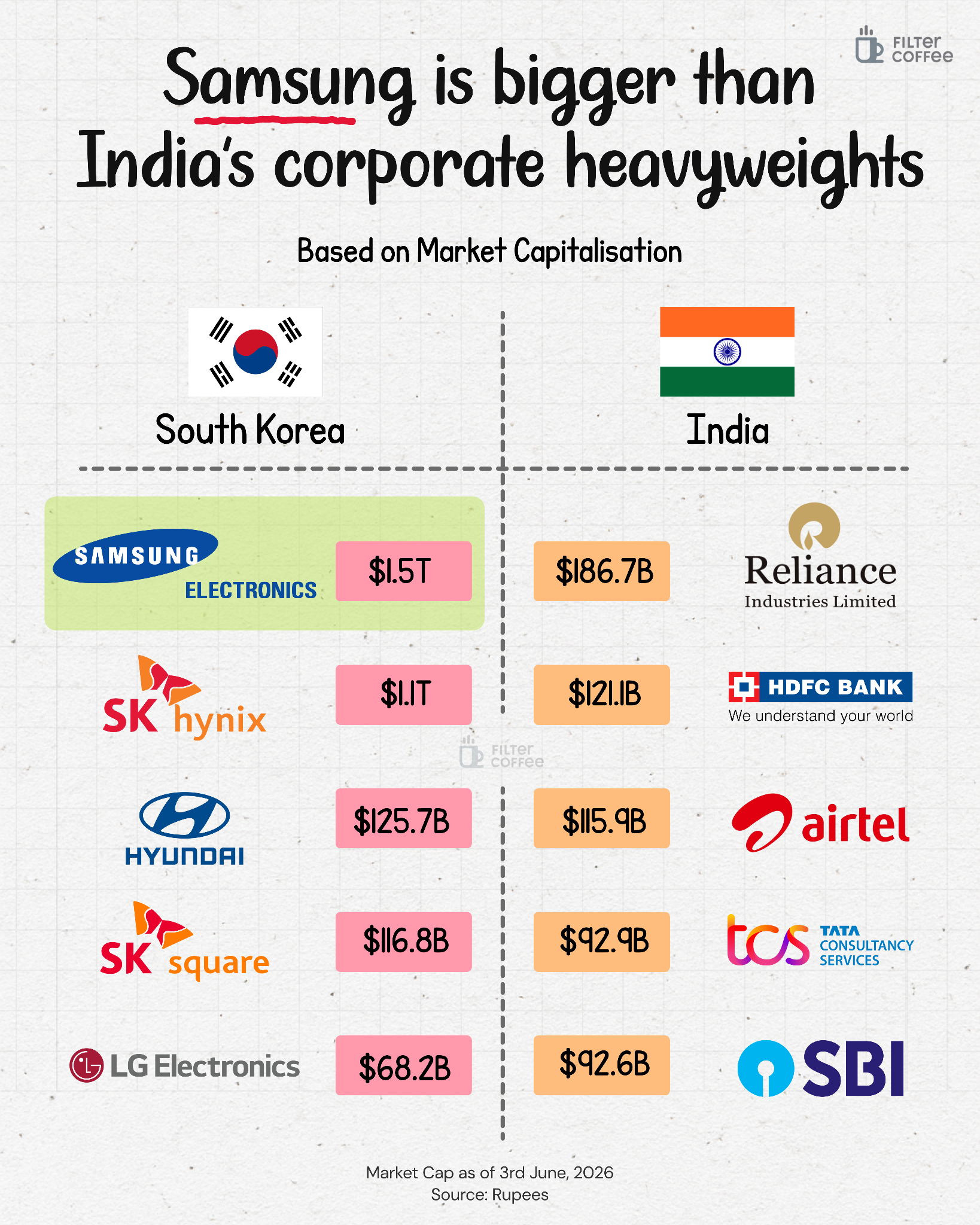
Samsung is now worth more than Reliance, HDFC Bank, Airtel, TCS and SBI combined.
As of early June 2026, Samsung Electronics was valued at roughly $1.5 trillion. Reliance Industries, India's most valuable company, was worth around $187 billion. Even if you add India's biggest listed giants together, they still fall short of Samsung's market value.
The comparison became even more interesting when South Korea's stock market overtook India's in total market capitalization. Korea's listed companies are now worth about $5 trillion, while India's market stands around $4.8 trillion.
Also read: After Taiwan, South Korea beats India's market cap
See… India has a population of 1.4 billion people. South Korea has just over 50 million. India's economy is roughly twice the size of South Korea's. India has more listed companies, more investors, and one of the fastest-growing major economies in the world.
So how did South Korea pull ahead?
The answer starts with artificial intelligence.
For years, investors treated AI as mostly a software story. Companies building chatbots, AI assistants, image generators and productivity tools attracted attention. But as AI models became larger and more powerful, investors realised something important.
AI is actually a hardware story first.
Every ChatGPT query, every AI-generated image and every large language model runs on an enormous amount of computing infrastructure. Training advanced AI models requires thousands of specialised chips working together inside massive data centres. The companies making those chips and their components suddenly became some of the most important businesses in the world.
That is where South Korea entered the picture.
Samsung is not simply a smartphone company. In fact, smartphones are only one piece of a much larger machine.
Samsung is one of the world's biggest semiconductor manufacturers. It produces memory chips, logic chips, display panels, consumer electronics, batteries and various components that sit deep inside the global technology supply chain.
When AI demand exploded, demand for memory chips exploded with it.
Modern AI systems consume extraordinary amounts of memory. Every AI server requires high-performance memory modules that can move massive amounts of data between processors at extreme speeds. These specialised products are called High Bandwidth Memory, or HBM chips.
Also read: Taiwan overtakes India in stock markets!
They are becoming the picks-and-shovels business of the AI gold rush.
Companies like Nvidia need them. Microsoft needs them. Amazon needs them. Google needs them. Meta needs them.
The result is that memory chip manufacturers suddenly found themselves sitting in one of the most valuable positions in the global economy.
Samsung was already a major player.
But another Korean company, SK Hynix, emerged as an even bigger AI winner.
SK Hynix has become one of Nvidia's most important suppliers of advanced memory chips. Its market value crossed $1 trillion, making it one of the largest semiconductor companies in the world. Samsung responded by accelerating investments in next-generation HBM products and deepening relationships with AI infrastructure customers.
Together, Samsung and SK Hynix became the backbone of Korea's stock market rally.
The numbers explain the scale.
Samsung alone is valued at around $1.5 trillion. SK Hynix is worth roughly $1.1 trillion. Together, they account for more than half of India's entire market capitalisation gap with South Korea.
Also, stock markets do not reward size alone. They reward future earnings potential.
Investors believe AI demand will keep growing for years. Every new AI model requires more computing power. More computing power requires more advanced chips. More advanced chips require more memory.
That belief has pushed valuations of semiconductor companies to levels that would have looked unimaginable a few years ago.
Of course, this creates risks too.
The AI trade works wonderfully as long as demand keeps growing.
If hyperscalers slow spending, if AI adoption disappoints, or if new technologies reduce memory requirements, semiconductor valuations could come under pressure. Markets have a habit of pricing in perfection long before perfection arrives.
Samsung itself understands this risk.
That is why it continues spending aggressively on research, manufacturing capacity and next-generation semiconductor technologies. Reports suggest Samsung plans to invest tens of billions of dollars this year alone across semiconductor manufacturing and R&D. The goal is simple: stay relevant in a world where AI infrastructure demand may determine the next decade of technology leadership.