

 Newsletter

Tata Power has announced that it is set to finalise a massive 10 GW wafer and ingot project worth ₹6,500 crore by January next year.
Ingots and wafers are critical inputs in solar panel manufacturing. Purified silicon is first formed into ingots, which are then sliced into wafers and processed into solar cells.
A 10 GW capacity facility can generate enough power to supply 50-60 lakh Indian households on average and help avoid 8-10 million tonnes of CO₂ emissions each year.
The deets: the company is evaluating multiple locations across states such as Odisha, Tamil Nadu, and Andhra Pradesh. According to the company, the final site will be decided after reviewing state-specific policies and available incentives
Why it matters: setting up a wafer and ingot project would make Tata Power a fully integrated solar manufacturing player. The company already has capabilities in solar cell and module production.
Big picture: India has strong solar capacity with 64 GW of modules and 12-15 GW of cells, but wafer and ingot manufacturing remains negligible. As a result, the country imports almost all its ingots, wafers, and polysilicon, according to Moneycontrol.
Building domestic capacity would help Indian manufacturers control technology, quality, and wafer design, and better adopt next-generation cells like TOPCon and HJT.
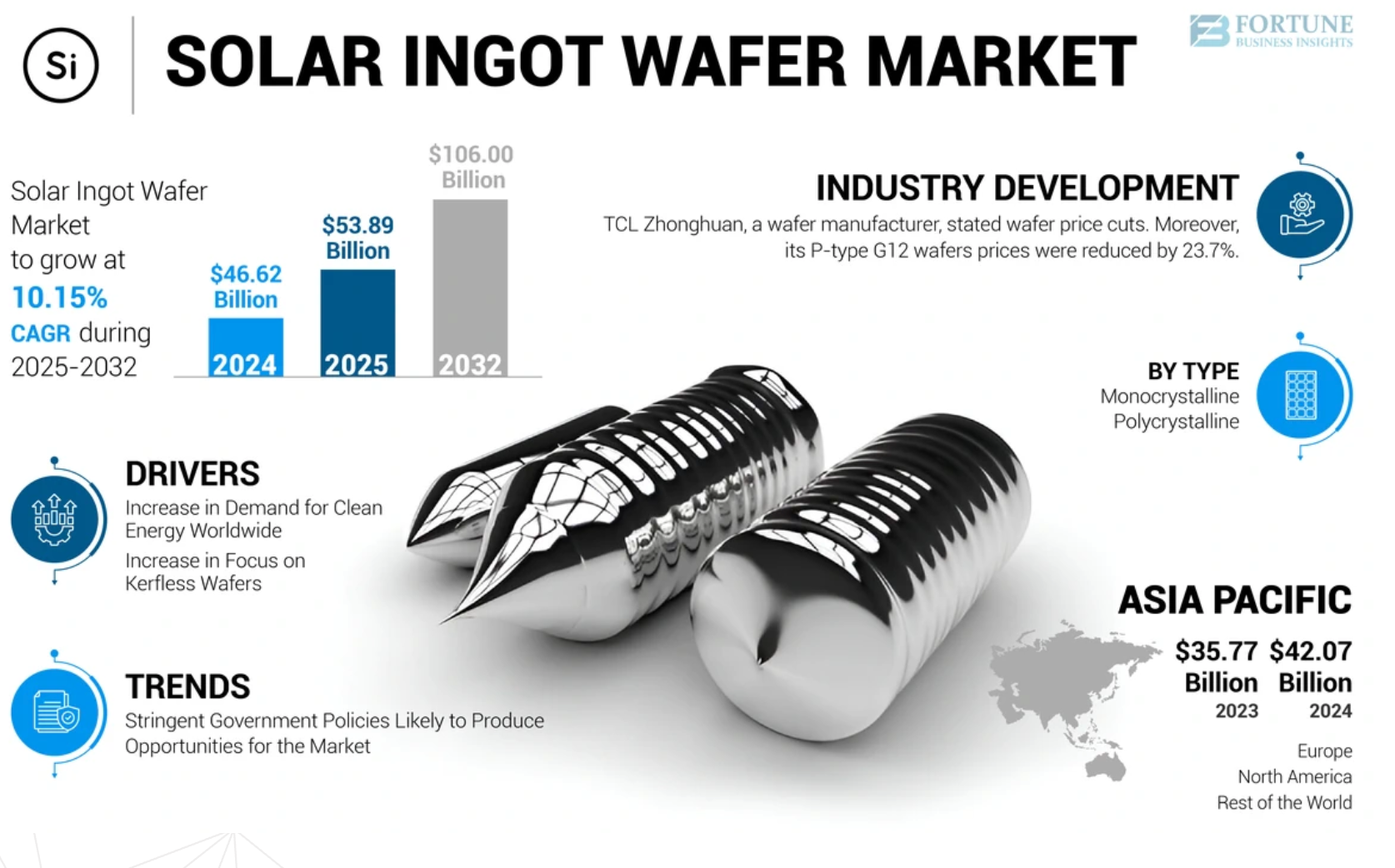
Fortune Business Insights