

 Newsletter
When the National Testing Agency cancelled NEET UG 2026 after allegations of a major paper leak, it shook one of the most competitive exams in the country once again.
Investigators reportedly found that over 100 questions from a so-called “guess paper” matched the actual exam, while the CBI later uncovered an alleged network involving coaching links, school officials and leaked PDFs reportedly sold for as much as ₹2-₹5 lakhs.
The controversy became so serious that the Supreme Court pulled up the NTA, saying it had still not learnt lessons from previous exam scandals.
But the outrage around NEET is about the scale of pressure surrounding medical education in India.
In NEET UG 2025, out of nearly 22.7 lakh students who appeared for the exam, more than 12.36 lakh qualified conveying that over half the students cleared one of the toughest entrance filters in the country.
But the bigger story was hidden inside the state-wise numbers.
NEET, or the National Eligibility cum Entrance Test, is India’s main entrance exam for students who want to become doctors. Every year, millions compete in this single exam for a limited number of medical seats, making it one of the toughest and most stressful career races in the country.
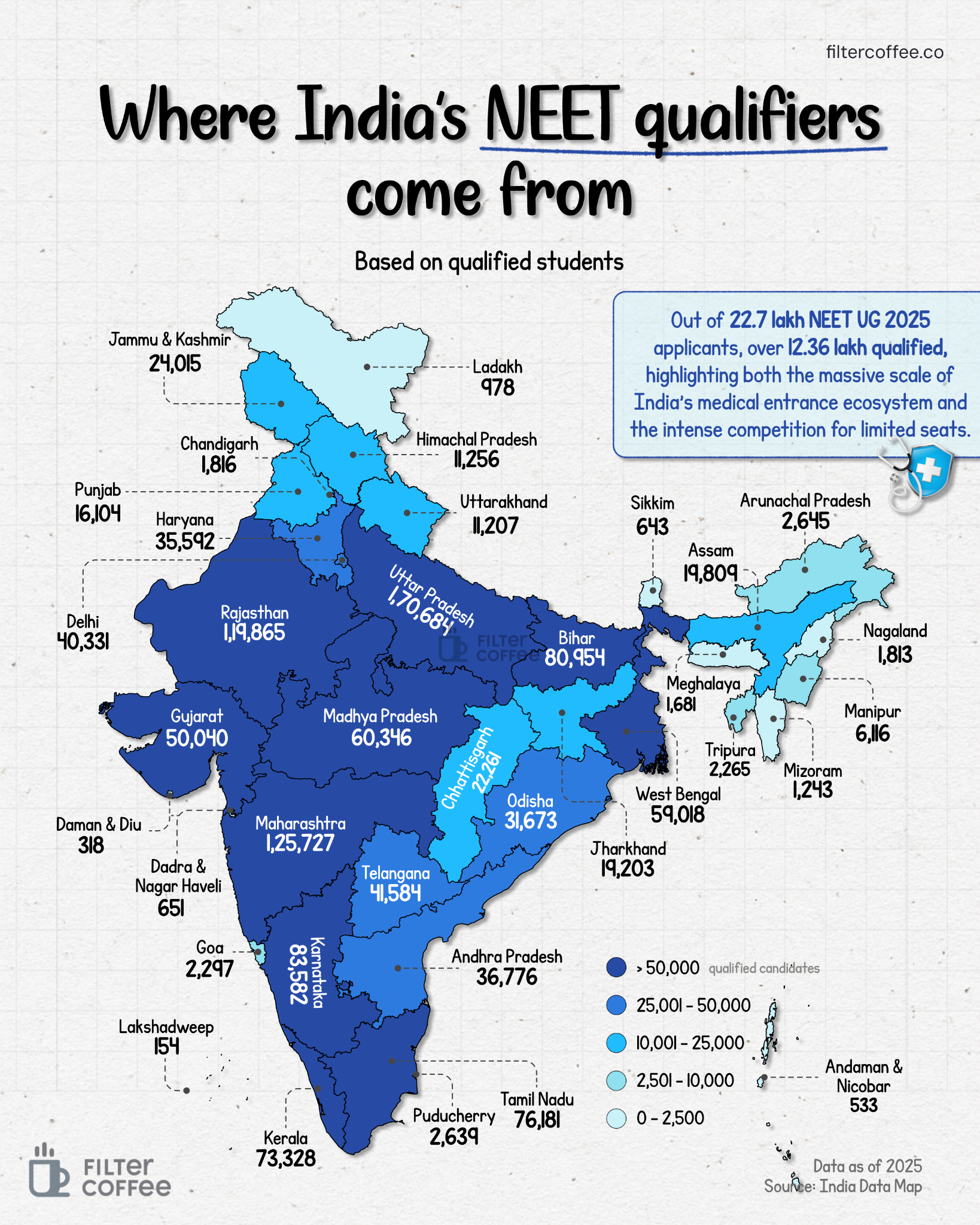
Uttar Pradesh alone produced more than 1.7 lakh qualified candidates. Maharashtra crossed 1.25 lakh. Rajasthan came close to 1.2 lakh. Karnataka, Bihar, Tamil Nadu and Kerala were not far behind either.
A handful of states are now producing a massive share of India’s future doctors, or at least students trying desperately to become one.
And that immediately raises a question. Why are so many young Indians chasing medicine even when the odds remain brutally difficult?
Because medicine in India has become one of the country’s biggest middle-class aspirations.
For decades, engineering dominated India’s entrance exam culture. Kota became the symbol of IIT dreams. But slowly, something changed. Engineering seats exploded across private colleges, salaries became uneven and stories of unemployed graduates started growing.
Medicine meanwhile retained its prestige. Doctors still represented stability, respect, income security and social mobility, especially for middle-class families outside metro cities. In many households, becoming a doctor is still seen as the ultimate career achievement.
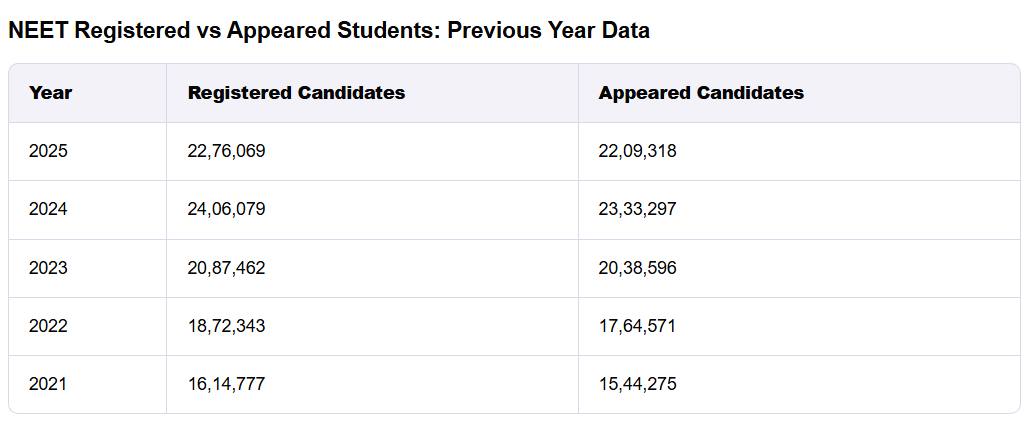
The numbers show this shift clearly. NEET registrations have exploded from around 7.5 lakh candidates in 2016 to over 22 lakh today. That is almost a threefold jump in less than a decade.
But here is where the story becomes intense. Qualifying NEET and actually getting an MBBS seat are two very different things.
India currently has around 1.15 lakh MBBS seats while over 12 lakh students qualified in 2025. Which means more than 10 lakh qualified students may still not get an MBBS seat this year. And government colleges, where fees are affordable, are even more competitive because they account for only a fraction of total seats.
This mismatch has created an entire parallel economy around medical preparation. Coaching centres, online edtech platforms, hostel chains, test series businesses and counselling consultancies are all feeding off India’s doctor dream.
Kota itself has increasingly shifted from being only an IIT coaching hub to becoming a NEET preparation factory. Rajasthan’s unusually high qualifier count is due to the same reason as thousands of students from across India migrate there every year solely for medical coaching.
And the pressure begins absurdly early now as students start preparing in Class 8 or 9. Some families spend several lakhs on coaching over multiple years.
Repeat attempts have become common. In many cases, students take gap years only to improve their NEET rank by a few thousand positions because even tiny rank differences can decide whether someone gets a government seat or not.
This pressure has also exposed one of the darkest sides of India’s entrance exam culture.
Kota being the country’s coaching capital, has repeatedly witnessed rising student suicides linked to academic stress, isolation and performance pressure.
According to Rajasthan Police data, Kota recorded 26 student suicides in 2023, one of the highest ever reported in the city. Even after national outrage and stricter guidelines for coaching centres, deaths continued in 2024 and 2025 as students struggled with the emotional burden of constant competition.
Mental health experts have repeatedly warned that India’s entrance exam ecosystem is creating extreme psychological stress among teenagers, especially those living away from home in coaching hubs for years at a stretch.
And yet the demand keeps rising.
Because underneath all the stress, competition and controversy lies one uncomfortable reality.
India still does not have enough doctors for its massive population. The WHO recommends a doctor-population ratio of 1:1000. India has improved sharply over the years, but healthcare access remains uneven, especially outside major cities.
The government knows this pressure is becoming unsustainable. That is why India has been rapidly expanding medical education capacity. Between 2020 and 2025 alone, the country added tens of thousands of MBBS and postgraduate medical seats. India now has more than 820 medical colleges and over 1.29 lakh MBBS seats according to National Medical Commission data.
But even this expansion has not solved the problem because demand is growing faster than supply.
There is also another hidden layer here.
The map of NEET qualifiers mirrors India’s broader economic geography. Large states with huge populations naturally dominate absolute numbers, but coaching access matters too. Urbanisation matters. Internet penetration matters. Family income matters.
States with stronger private school ecosystems and coaching infrastructure tend to produce more qualifiers. Smaller northeastern states often have lower absolute numbers not because ambition is lower, but because access to preparation ecosystems is weaker.
Then comes the controversy layer.
NEET has increasingly become one of India’s most politically sensitive exams. The 2024 paper leak controversy triggered nationwide protests, court cases and investigations. In 2025 and even into 2026, questions around exam integrity, NTA’s functioning and coaching culture continue to dominate headlines. Every year, millions of families place enormous emotional and financial stakes on this one exam and that’s why even minor irregularities create national outrage.
That is why the NEET story is much bigger than an entrance exam. It is a story about India’s middle class, its education system, its healthcare gaps and its growing anxiety around economic security.
Every year, millions of teenagers enter this race hoping for one seat in one college that could completely change their family’s future. And every year, the competition becomes even larger than before.