

 Newsletter

What would make you quit your job?
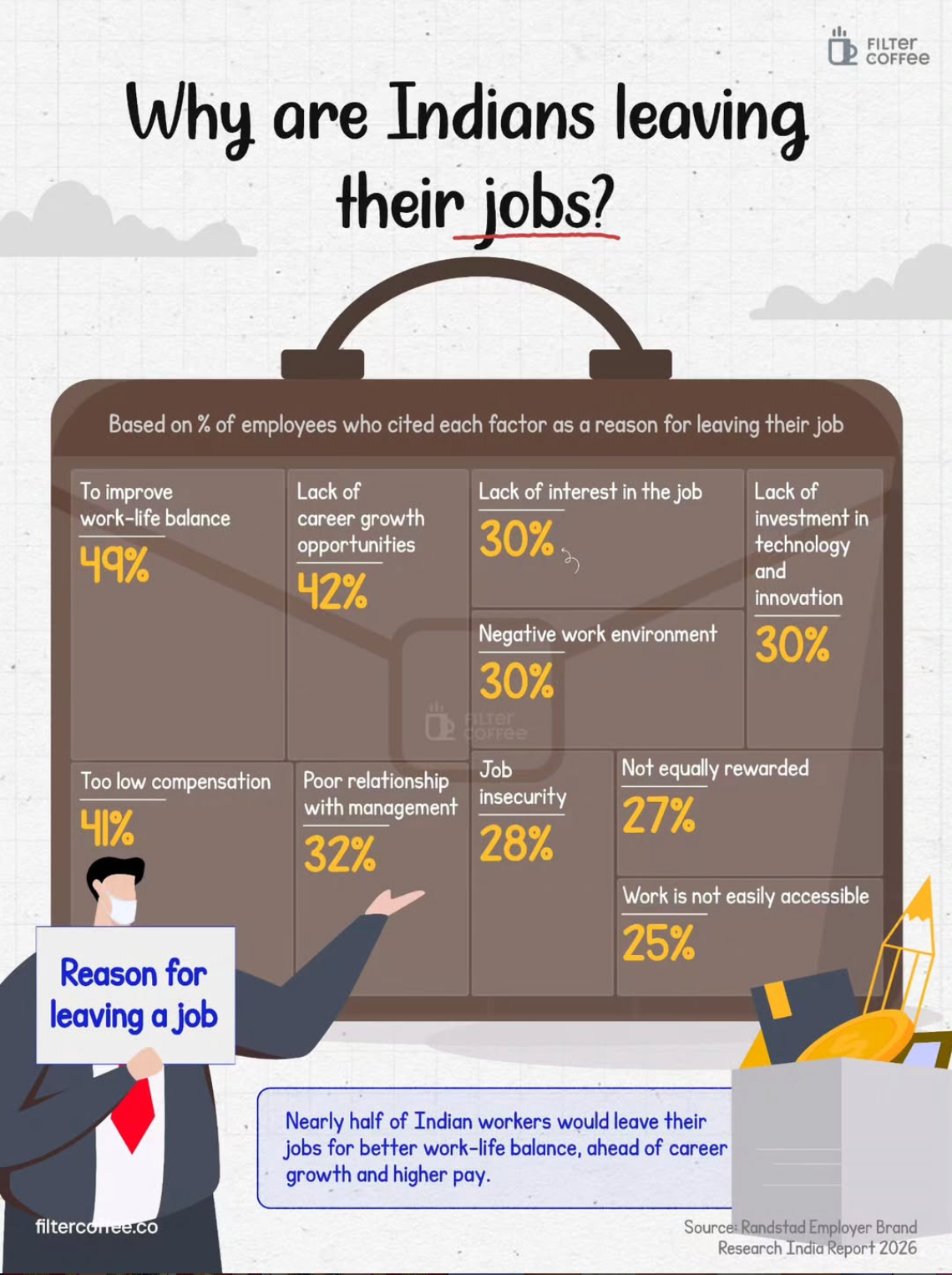
For 49% of Indian employees, the answer is not a bigger salary. It is a better work-life balance. Randstad’s 2026 Employer Brand Research found that 46% of Indian employees are considering changing jobs within the next six months, while 32% had already changed employers in the six months before the survey.

The reasons range from long working hours and limited career opportunities to pay and management. Work-life balance was the biggest factor, cited by 49% of respondents, followed by lack of career growth at 42% and low compensation at 41%. Poor relationships with management came in at 32%, while 30% of employees said they were looking for more interesting work and another 30% pointed to insufficient investment in technology and innovation.
Salary, of course, still matters. But the numbers suggest that employees are weighing the entire experience of having a job rather than just the monthly pay cheque. Someone might be offered a 20% raise, but if that comes with longer hours, a difficult commute and little time outside work, the decision becomes less straightforward. The same applies to career growth. If someone has spent three or four years in the same role without learning much or seeing a clear path to the next position, another company can become attractive even without offering a dramatically higher salary.
The workplace itself has also changed. 42% of Indian respondents now work in a hybrid setup, and opportunities for learning and development have become an important part of how employees judge an employer. For younger workers in particular, career progression appears to carry considerable weight.
There is also a broader engagement problem. Gallup’s 2026 workplace research found that only 23% of Indian employees were engaged at work in 2025, down from 33% in 2022. Another 59% were classified as “not engaged”. That does not necessarily mean they hate their jobs or are preparing to resign. It can simply mean that they turn up, finish what they have to do and go home without feeling particularly connected to the work.
That is where the job-switching numbers become important for companies. An employee who has stopped seeing a future in the organisation may not announce it immediately. They could spend months updating their CV, speaking to recruiters and waiting for the right opportunity before finally putting in their notice.
For employers, retaining people is therefore becoming a little more complicated. Competitive pay remains essential, but so are reasonable working hours, good managers, opportunities to move up and work that does not leave people feeling stuck.
India’s workforce is not suddenly losing its appetite for work. It seems to be becoming more particular about what it gets in return for the time it puts in.