
 Newsletter

India’s renewable energy story crossed a symbolic milestone recently.
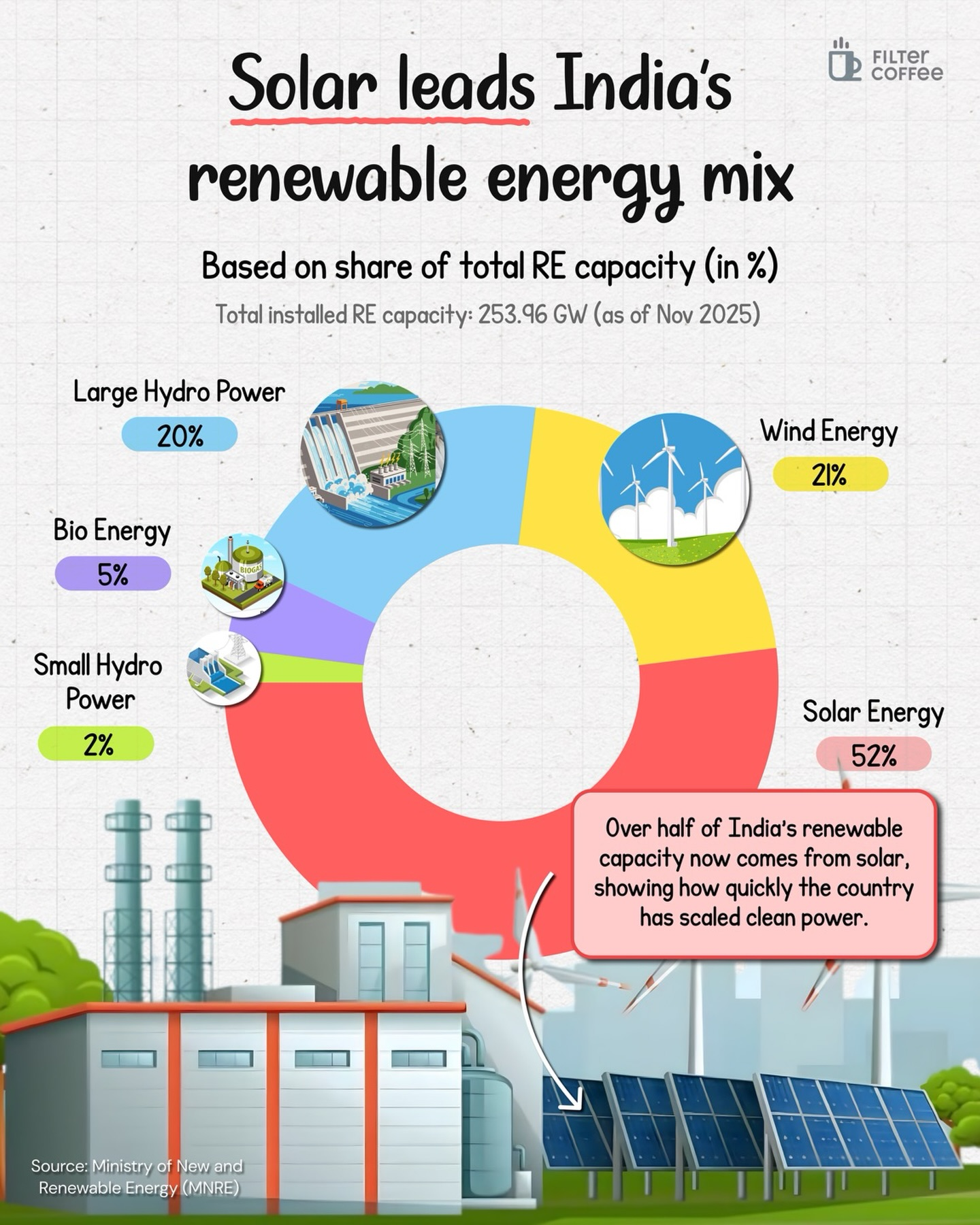
According to the latest data from the Ministry of New and Renewable Energy, the country now has about 254 gigawatts of installed renewable power capacity, and more than half of that comes from solar energy alone.
Solar now accounts for roughly 52% of India’s renewable energy mix, comfortably ahead of wind, hydro and bioenergy. In other words, if you put together every wind turbine, hydro dam, biomass plant and solar farm in the country, solar panels alone now make up the largest slice of India’s clean power system.
And that tells us something important about how India’s energy transition is actually unfolding.
Let’s rewind a decade.
Around 2014, India’s solar capacity was barely 2.6 gigawatts. Today it is well above 110 gigawatts. That’s a nearly 50-fold jump in just over ten years.
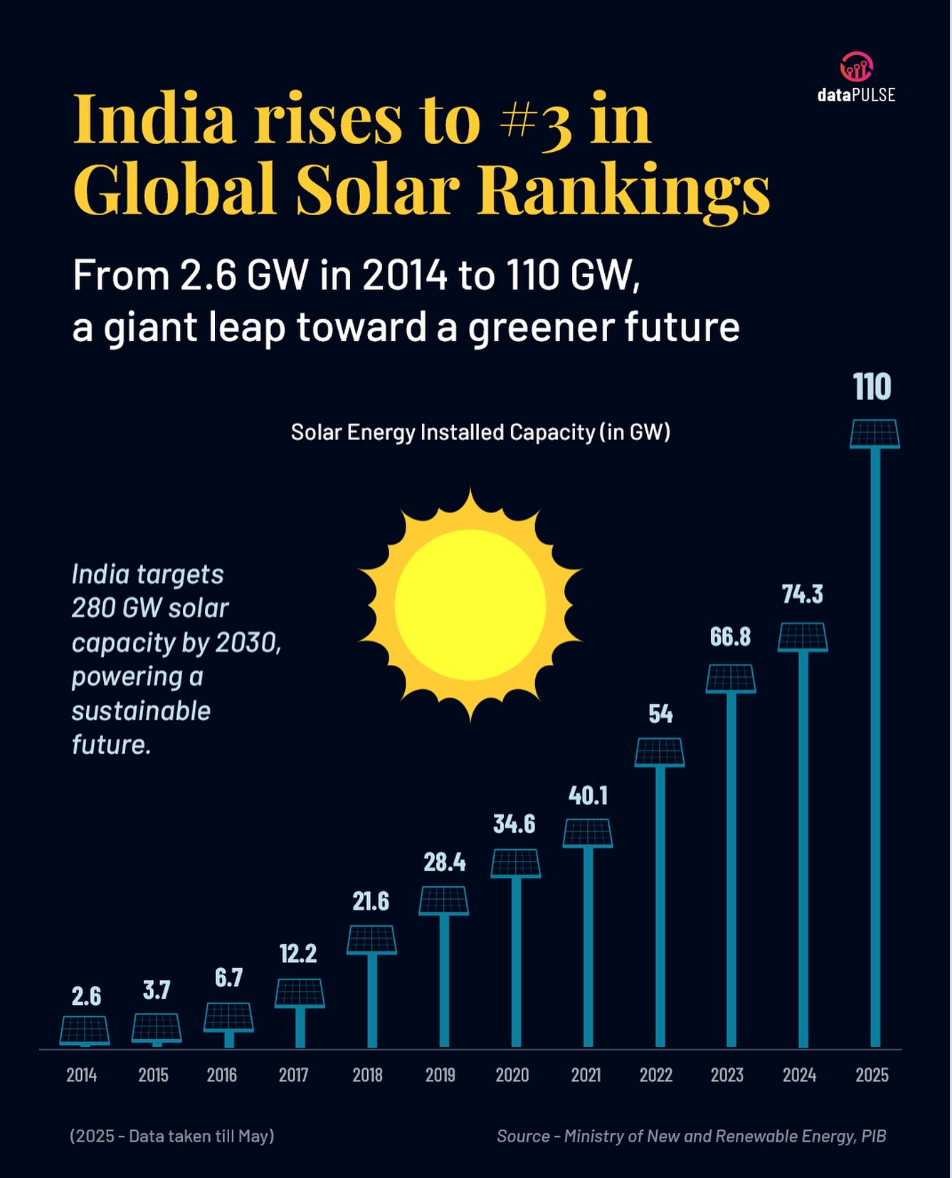
Few energy technologies anywhere in the world have scaled this quickly in such a large market. Wind energy, which once dominated India’s renewable sector, now accounts for roughly 21% of installed renewable capacity, while large hydro contributes about 20%. Bioenergy and small hydro together form only a small share. The shift is clear.
India’s clean energy push has effectively become a solar story.
The obvious question is why solar took the lead so decisively.
One reason is cost. Over the last decade, solar power has become one of the cheapest sources of electricity in India. Utility-scale solar tariffs discovered through government auctions have dropped to around ₹2.4 to ₹2.6 per unit in many projects.
That is often cheaper than building a new coal plant and significantly cheaper than gas-based power. Once solar became the lowest-cost option, the economics started driving the transition. State utilities, corporate buyers and developers naturally began favouring it.
Speed also plays a role. Building a coal plant or a large hydro project can take five to ten years because of land acquisition, environmental approvals and construction complexity. A solar park, on the other hand, can be built in 12 to 18 months. That difference in timelines matters when a country like India needs to rapidly add electricity capacity to support economic growth. Faster construction means faster returns for developers and quicker additions to the grid.
Geography helps too. India sits in what energy analysts often call the global solar belt, a region that receives abundant sunlight throughout the year.
States such as Rajasthan, Gujarat, Tamil Nadu and Maharashtra have vast stretches of land suitable for solar parks. Rajasthan alone has already crossed 36 gigawatts of installed solar capacity, making it one of the largest solar generating regions in the world. Massive solar parks like Bhadla in Rajasthan have become icons of India’s renewable push.
Policy support has amplified this momentum. Over the past decade, the government has introduced several schemes to accelerate renewable adoption. These include large-scale solar park programs, rooftop solar subsidies, renewable purchase obligations for utilities, and production-linked incentives to encourage domestic solar manufacturing. India has also set an ambitious target of reaching 500 gigawatts of non-fossil fuel electricity capacity by 2030. Solar is expected to deliver the biggest portion of that expansion.
Another layer of demand is now coming from companies themselves. Large corporations are increasingly signing long-term renewable power agreements to meet sustainability goals and reduce energy costs. This trend, known as corporate renewable procurement, is expected to add tens of gigawatts of capacity over the next few years. Some projections suggest corporate renewable capacity in India could reach around 57 gigawatts by FY2028, driven by sectors like manufacturing, data centres and technology services.
But the rise of solar also reveals a subtle challenge in India’s power system. Installed capacity is not the same thing as electricity generation. Solar plants produce power only during daylight hours, and wind generation depends on weather conditions. As a result, even though renewables account for roughly half of India’s installed power capacity today, they still generate less than one-third of the country’s total electricity output.
Coal plants continue to run more consistently through the day and night, which is why they still dominate actual power generation.
This is where the next phase of the renewable transition begins. As solar capacity keeps growing, the grid will need ways to balance supply and demand when the sun isn’t shining. That means large investments in battery storage, pumped hydro storage, hybrid solar-wind projects and stronger transmission networks. India has already begun planning massive green energy corridors to move renewable power from sunny and windy regions to industrial centres.
The scale of upcoming projects also shows how quickly this sector is expanding. It is estimated that over 130 gigawatts of renewable capacity is currently under development or tendering across the country. Solar will likely continue to dominate these additions because the economics still favour it. Meanwhile, new technologies such as offshore wind, green hydrogen production and grid-scale battery systems are slowly entering the pipeline.
The closing: India’s energy transition is no longer just about adding a few wind farms or hydro dams. It is about building one of the world’s largest solar ecosystems, supported by manufacturing, infrastructure and policy frameworks designed to scale clean power at unprecedented speed. And if the past decade is any indication, the next ten years could see this solar story grow even bigger.