
 Newsletter
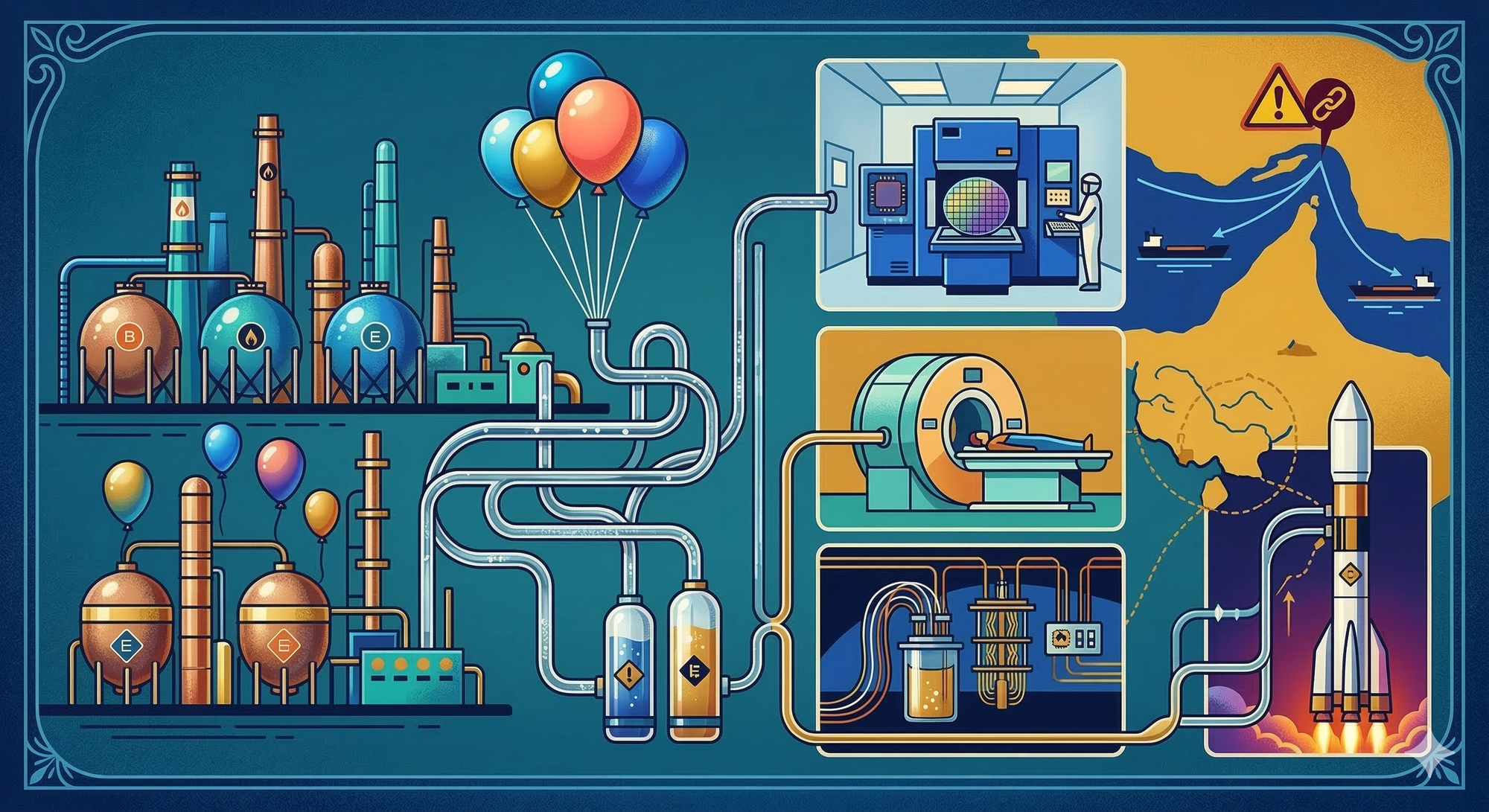
Over the past few weeks, most of the attention around the Middle East conflict has been on oil prices and shipping routes.
But another supply chain quietly caught the attention of the tech industry.
Helium.
The gas most people associate with party balloons is also a critical input in semiconductor manufacturing, medical imaging, and scientific research. And right now, a combination of disrupted LNG production in Qatar and shipping uncertainty around the Strait of Hormuz is raising concerns about how smoothly that helium supply will move around the world.
No immediate crisis yet. But if the disruption drags on, industries that depend on helium could start feeling the pressure. And right now, a large portion of the global supply chain that moves helium around the world is sitting directly in the middle of a geopolitical conflict.
To understand why that matters, you have to start with how helium actually reaches the global market. Unlike oil or copper, helium is not something humans can manufacture at scale. It forms naturally underground over millions of years as radioactive elements slowly decay inside rocks.
Those helium atoms eventually get trapped in the same reservoirs that contain natural gas. When companies extract natural gas, small quantities of helium come up with it. If the concentration is high enough, it can be separated, liquefied, and sold.
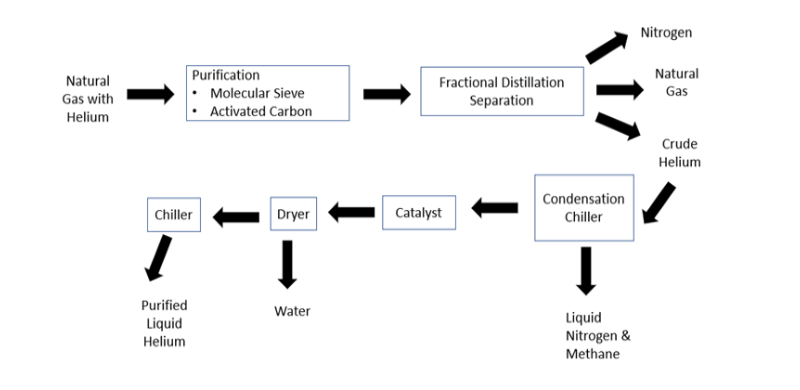
Image Credit: EFC Gases & Advanced Materials
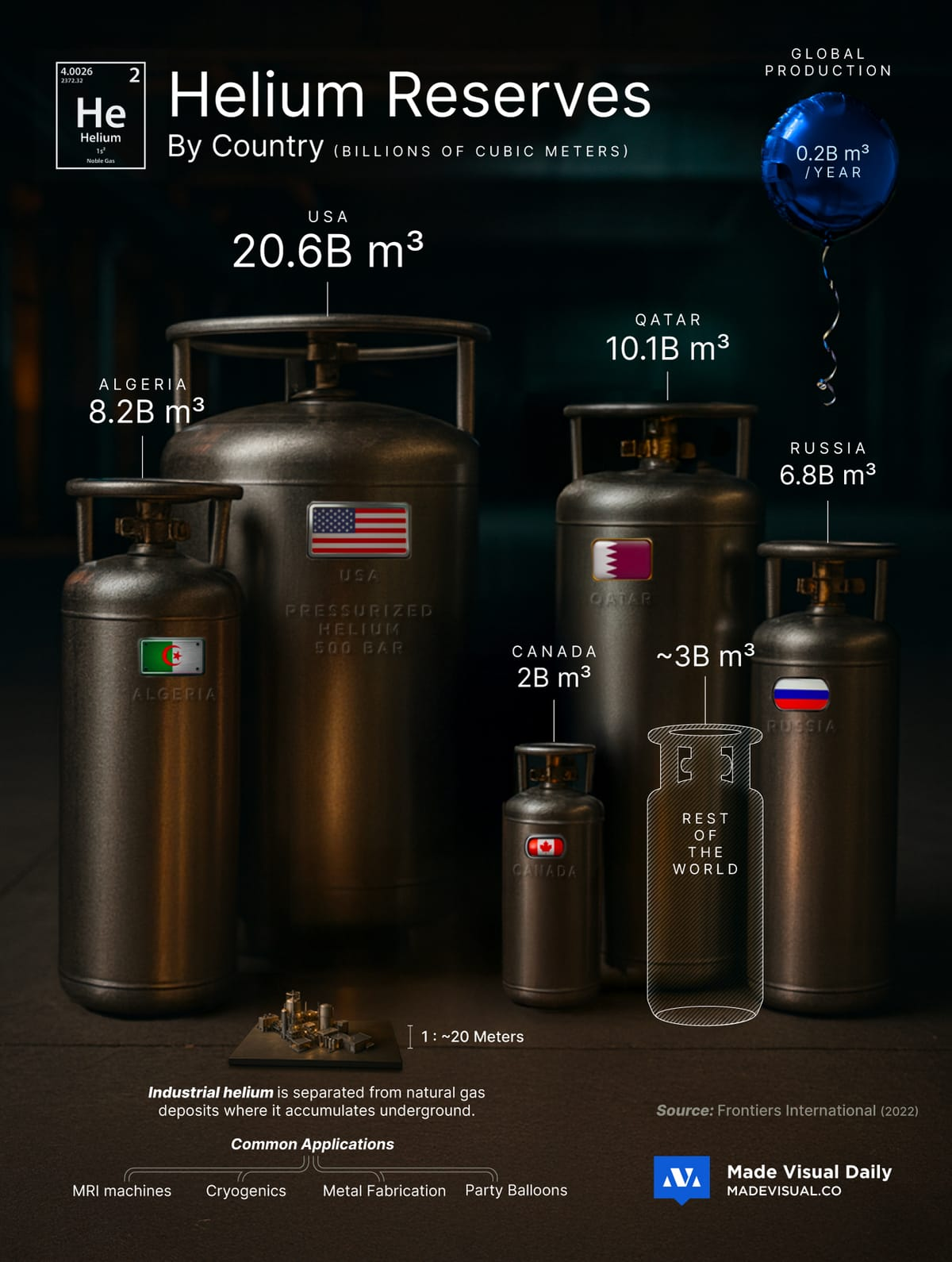
This is why the geography of helium production is extremely concentrated. A handful of regions dominate global supply. The United States produces half of the world's helium. Qatar is the second largest supplier, depending on the year. Algeria and Russia contribute smaller shares, while new projects are emerging in places like Canada and Tanzania. In other words, a surprisingly large chunk of the global helium supply comes from just a few facilities connected to the natural gas industry.
Qatar’s Ras Laffan Industrial City is one of those facilities. It is one of the largest LNG complexes on Earth, and the helium extracted during its gas processing flows into the global market. Under normal conditions, that helium is liquefied, loaded into specialized cryogenic containers, and shipped through the Strait of Hormuz before reaching industrial customers around the world.
That route is now under pressure.
The Strait of Hormuz is one of the most important shipping chokepoints in the global economy. Roughly a fifth of the world’s oil and a large share of LNG exports pass through this narrow waterway between Iran and Oman. When tensions in the region rise, shipping companies, insurers, and traders immediately begin adjusting their risk calculations. The current conflict has already forced rerouting of vessels and raised fears of a temporary blockade. Even if ships are still technically able to pass through, the uncertainty alone can disrupt logistics.

Image Credit: Observer Research Foundation
For helium, that disruption is unusually dangerous because the supply chain is extremely fragile.
Unlike oil or metals, helium cannot be easily stockpiled for long periods. Liquid helium must be stored at temperatures close to minus 269 degrees Celsius. Even inside specialized containers it slowly boils off and escapes. Over time it literally leaks away. That means the global market operates on a relatively tight flow of continuous production and transport. If that flow gets interrupted, the shortage appears much faster than in most commodity markets.
And there are already signs of pressure. Industry analysts have warned that the shutdown in Qatar could temporarily remove up to one third of global helium supply from the market. Even if production resumes soon, it will take time to reposition containers, reroute shipments, and rebuild inventories. Some suppliers have already begun discussing price surcharges as uncertainty spreads through the market.
The semiconductor industry is watching closely.
Modern chip manufacturing is one of the most precise industrial processes humans have ever developed. Semiconductor fabrication plants operate in ultra clean environments where silicon wafers are etched and layered using highly specialized equipment. Many of those machines rely on helium because it is chemically inert and extremely good at transferring heat. It helps cool sensitive components, maintain stable manufacturing conditions, and detect microscopic leaks in complex vacuum systems.
The industry does not use helium in massive volumes compared to other gases, but it needs extremely high purity and reliable supply. If shipments become inconsistent, fabs cannot simply swap it out overnight. Some processes can substitute other gases like argon or hydrogen, but many steps still rely heavily on helium. That is why semiconductor manufacturers monitor helium markets as carefully as they monitor silicon wafers or rare metals.
South Korea is particularly exposed to this risk. The country is the world’s largest producer of memory chips, with companies like Samsung Electronics and SK Hynix dominating global supply of DRAM and advanced high bandwidth memory used in AI hardware.
According to industry data, South Korea imported roughly two thirds of its helium from Qatar last year. That concentration makes the situation uncomfortable for Korean chipmakers, although most large fabs maintain several months of strategic inventory and have begun installing helium recycling systems to reduce dependence on fresh supply.
For now, the industry is not in immediate crisis. Semiconductor companies generally hold buffers of several weeks or months for critical gases. Some experts estimate that Korean chipmakers could manage for around six months if supply disruptions continue. That buys time for alternative shipments from the United States or other suppliers to fill the gap.
But the real risk lies in duration.
If the conflict in the Gulf resolves quickly and Qatar’s LNG facilities return to normal operations, the helium market will likely experience only a temporary squeeze. Prices may rise and logistics may take time to stabilize, but the supply chain would eventually recover.
If the disruption drags on for several months, the situation becomes more complicated. Helium supply chains are slow to rebalance because specialized containers must circulate between production facilities and customers. When shipments are delayed or rerouted, the entire logistics network falls out of rhythm. Even after production resumes, it can take months for the system to return to normal.
And semiconductors are not the only sector competing for helium.
Hospitals are actually the largest consumers of helium globally. The gas is used to cool superconducting magnets inside MRI scanners, which rely on extremely low temperatures to generate powerful magnetic fields. A typical MRI machine can contain thousands of litres of liquid helium. If the cooling system fails, the magnet can “quench,” meaning the helium evaporates and the machine stops working until it is refilled. Replacing that lost helium is expensive and sometimes difficult during shortages.
Scientific research facilities also rely heavily on helium. Particle accelerators, nuclear magnetic resonance spectrometers, and quantum computing experiments all require cryogenic cooling. Even space agencies use helium to pressurize rocket fuel tanks and purge propulsion systems before launch. In short, helium quietly underpins a wide range of advanced technologies that modern economies depend on.
This is not the first time the world has confronted this problem. Over the past two decades the global helium market has experienced multiple shortages. Fires at Russia’s Amur gas processing plant, maintenance shutdowns in Qatar, and disruptions to the United States’ federal helium reserve have all triggered supply crunches at different times. The most recent major shortage began in 2022 when several of these events happened simultaneously, pushing prices sharply higher and forcing laboratories and hospitals to ration usage.
That episode exposed how fragile the helium ecosystem really is. It also triggered a wave of efforts to reduce dependence on fresh supply.
One response has been recycling. Large industrial users are increasingly installing helium recovery systems that capture gas after it evaporates from equipment, purify it, and return it to the system. Some facilities claim these technologies can recover up to 90 percent of the helium they consume. Semiconductor manufacturers and research labs have been investing heavily in these systems because they offer protection against both shortages and rising prices.
Another response has been exploration. Historically helium was only collected as a byproduct of natural gas extraction. But new companies are now searching specifically for helium-rich deposits. In Tanzania, geologists discovered one of the world’s largest known helium reserves in 2016, and production is expected to ramp up in the coming years. Similar projects are emerging in Canada and the United States as investors realize that helium could become strategically important.
There is also innovation in equipment design. Some MRI manufacturers are developing scanners that require dramatically less helium. New models can operate with only a litre or two of helium sealed inside the system rather than thousands of litres. While these machines are still expensive and not yet widespread, they hint at a future where medical imaging becomes less vulnerable to helium shortages.
Still, none of these solutions can eliminate the problem overnight. Helium is fundamentally difficult to replace because of its unique physical properties. It has the lowest boiling point of any element and remains chemically inert under almost all conditions. Those characteristics make it ideal for cryogenic cooling and ultra clean industrial processes, but they also mean that no other gas behaves exactly the same way.
The geopolitical dimension of the market is also becoming harder to ignore.
Energy chokepoints like the Strait of Hormuz are usually discussed in terms of oil and natural gas. But the modern economy relies on a far broader set of materials moving through those same routes. When conflicts threaten shipping lanes, the consequences ripple through unexpected industries, from fertilizers and chemicals to semiconductors and medical technology.
For countries like India, this interconnectedness creates both risk and urgency.
India is currently trying to build a domestic semiconductor ecosystem through government incentives and partnerships with global manufacturers. The country recently inaugurated a major semiconductor assembly and testing facility operated by Micron in Gujarat, and several other fabrication and packaging projects are under development. These investments are part of a long term strategy to reduce dependence on imported electronics and participate more deeply in the global chip supply chain.
But building semiconductor capacity is not just about constructing factories. It also requires securing reliable access to hundreds of specialized materials and gases that keep those factories running. Helium is one of those invisible dependencies. If global supply chains become unstable, new semiconductor projects in emerging manufacturing hubs could face delays or higher operating costs.
Whether the current situation becomes a full blown supply crisis depends largely on how long the Middle East conflict continues to disrupt production and shipping. If tensions ease and exports resume, the market will likely absorb the shock. But if the disruptions persist, the global helium market could once again enter a period of tight supply, rising prices, and strategic competition.
And if that happens, the ripple effects will reach much further than balloons. They will stretch all the way from hospital imaging rooms to semiconductor clean rooms to the rapidly expanding infrastructure of the AI economy.
Sometimes the most important resource in the global technology race is not a rare metal or a revolutionary algorithm.
It is an invisible gas that almost no one notices until the supply starts running out.
FAQs
Why is helium important for the semiconductor industry?
Helium plays a key role in semiconductor manufacturing because it helps cool sensitive equipment and maintain stable conditions inside chip fabrication plants. The gas is chemically inert and has excellent heat-transfer properties, which makes it useful for cooling wafer processing equipment and detecting leaks in vacuum systems. Without reliable helium supply, semiconductor fabs may face slower production, higher costs, or operational disruptions.
Is there a global helium shortage right now?
There is no full global helium shortage yet, but supply risks are increasing. Recent disruptions to LNG production in Qatar and uncertainty around shipping routes through the Strait of Hormuz have raised concerns about helium availability. Because helium is produced alongside natural gas, interruptions in gas processing can reduce global supply. If the situation continues for several weeks or months, the market could tighten significantly.
Why does helium supply depend on LNG production?
Helium is often extracted as a byproduct during natural gas processing. When natural gas is liquefied to produce LNG, small quantities of helium trapped in the gas reservoir are separated and purified. This means that when LNG production slows or stops, helium production usually falls as well. Major LNG facilities, particularly in countries like Qatar, therefore play an important role in the global helium supply chain.
How much of the world’s helium comes from Qatar?
Qatar is one of the world’s largest helium suppliers. Depending on the year, the country accounts for roughly 30% to 38% of global helium production. Much of this supply comes from the Ras Laffan Industrial City complex, where helium is extracted from natural gas during LNG processing. Any disruption to production or shipping from this facility can therefore affect helium markets around the world.
What industries depend on helium besides semiconductors?
Helium is used in several critical industries. Hospitals rely on it to cool superconducting magnets inside MRI machines. Scientific research labs use helium for cryogenic experiments and particle physics equipment. Aerospace companies use it to pressurize rocket fuel tanks. It is also used in leak detection, fiber-optic manufacturing, welding processes, and deep-sea diving breathing mixtures.
Why can’t helium be easily replaced by other gases?
Helium has unique physical properties that make it difficult to replace. It is chemically inert, extremely light, and has the lowest boiling point of any element. This allows it to remain stable at extremely low temperatures and transfer heat efficiently. These characteristics make helium ideal for cryogenic cooling and ultra-precise industrial processes, which is why alternatives often cannot fully replicate its performance.
Why is helium difficult to store or stockpile?
Helium is extremely difficult to store because the atoms are very small and can escape through tiny gaps in containers over time. Liquid helium must also be stored at extremely low temperatures, close to minus 269°C. Even under controlled conditions, the gas slowly evaporates and leaks away. This means long-term stockpiling is difficult, making the supply chain more sensitive to disruptions.
Could a helium shortage affect artificial intelligence and data centers?
Yes, indirectly. Advanced semiconductor chips used in AI servers and data centers require complex manufacturing processes that rely on helium. If helium supply becomes tight, semiconductor production could slow or become more expensive. This could affect the availability of high-performance chips used in AI infrastructure, although most chipmakers maintain inventory buffers to handle short-term disruptions.
How long could a helium supply disruption last?
Even if production resumes quickly, helium supply chains take time to stabilize. Liquid helium is transported in specialized cryogenic containers, and global logistics networks must be carefully coordinated. If a disruption lasts more than a few weeks, it can take several months for supply chains to rebalance and inventories to rebuild. During that period, prices may rise and industries may face tighter supply.
Can new helium discoveries solve future shortages?
New helium discoveries could help improve long-term supply, but they take years to develop. Recent helium reserves have been identified in places like Tanzania and Canada, and exploration companies are actively searching for new deposits. However, building extraction facilities, processing plants, and logistics networks takes significant time and investment. As a result, these projects are unlikely to solve short-term supply disruptions.