
 Newsletter

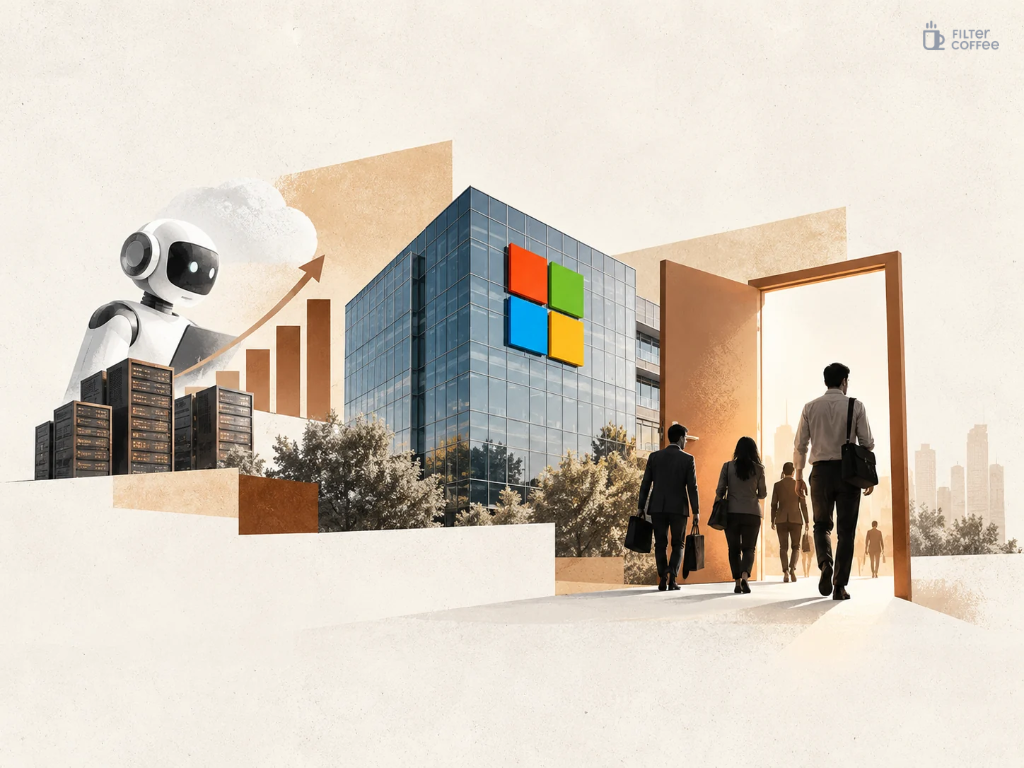
Microsoft is offering roughly 60,000 employees something unusual: the option to leave with financial support, even as it spends billions building its AI future. The technology giant announced its voluntary exit programme on 26 October, covering selected teams in the US, UK, Canada and India.
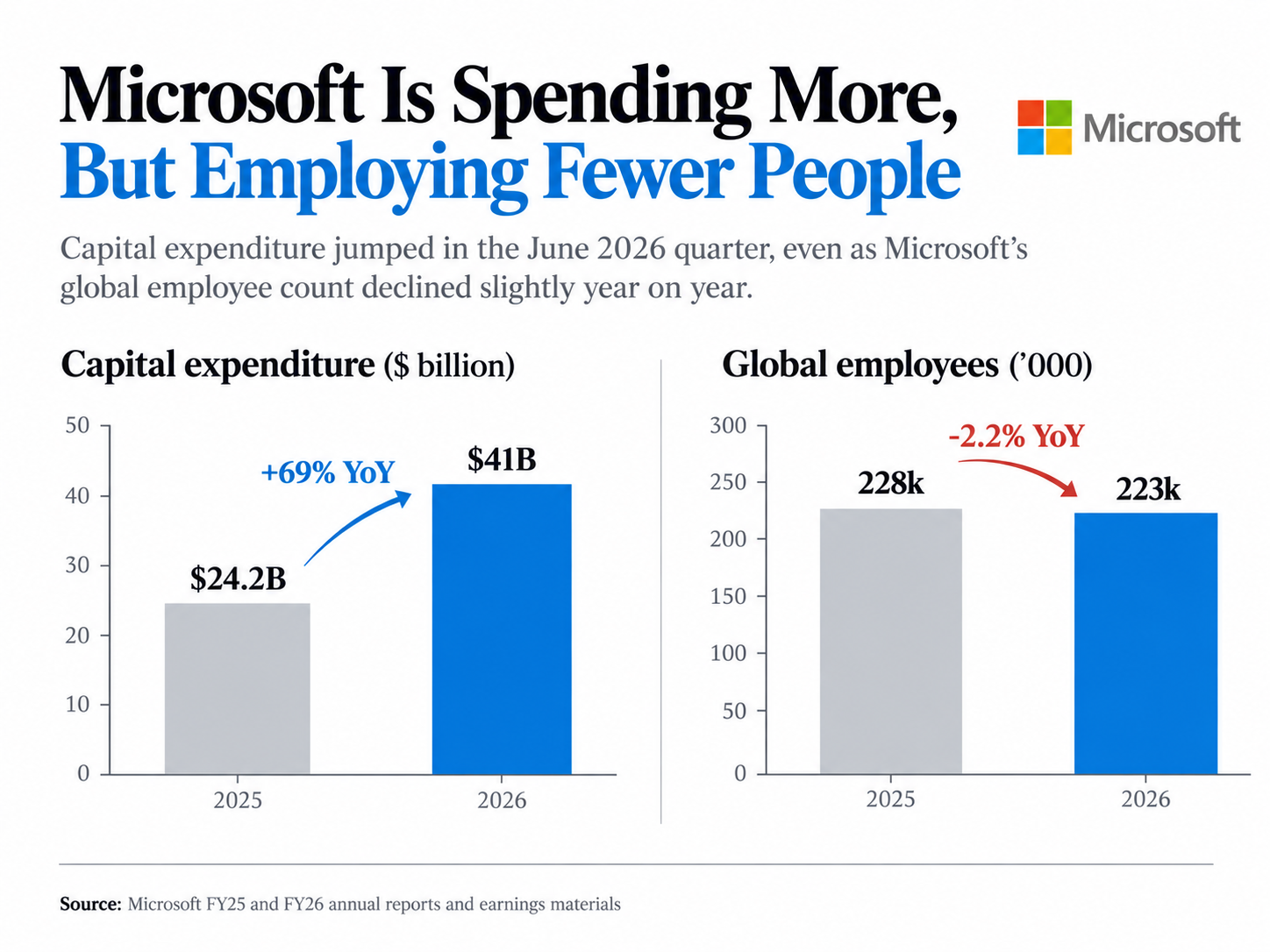
Those eligible represent about 27% of its global workforce of 223,000. But 60,000 people are not being laid off. They have been offered a choice, and Microsoft has not said how many it expects to take it.
The economics are striking. In the three months to June, Microsoft spent $41 billion on capital expenditure, much of it on chips and computing infrastructure serving AI and non-AI workloads. Its revenue for the full financial year climbed 18% to $331.8 billion, while net profit reached $133.7 billion. Microsoft isn't short of money. It is building an extremely expensive future while reviewing which people, roles and teams fit its changing priorities. Those two developments are happening together, though the company has not said AI automation is directly replacing the employees being offered a way out.
The offer extends to employees at Microsoft's internal level 70 and below in participating divisions. According to Reuters, the eligible groups include Copilot, AI experiences, Windows, Xbox, finance and human resources. Marketing, parts of the commercial business and security are among those excluded. So even some teams working on AI products have received the option to leave. Microsoft says participation depends on each division's needs and customer commitments, rather than a single company-wide rule.
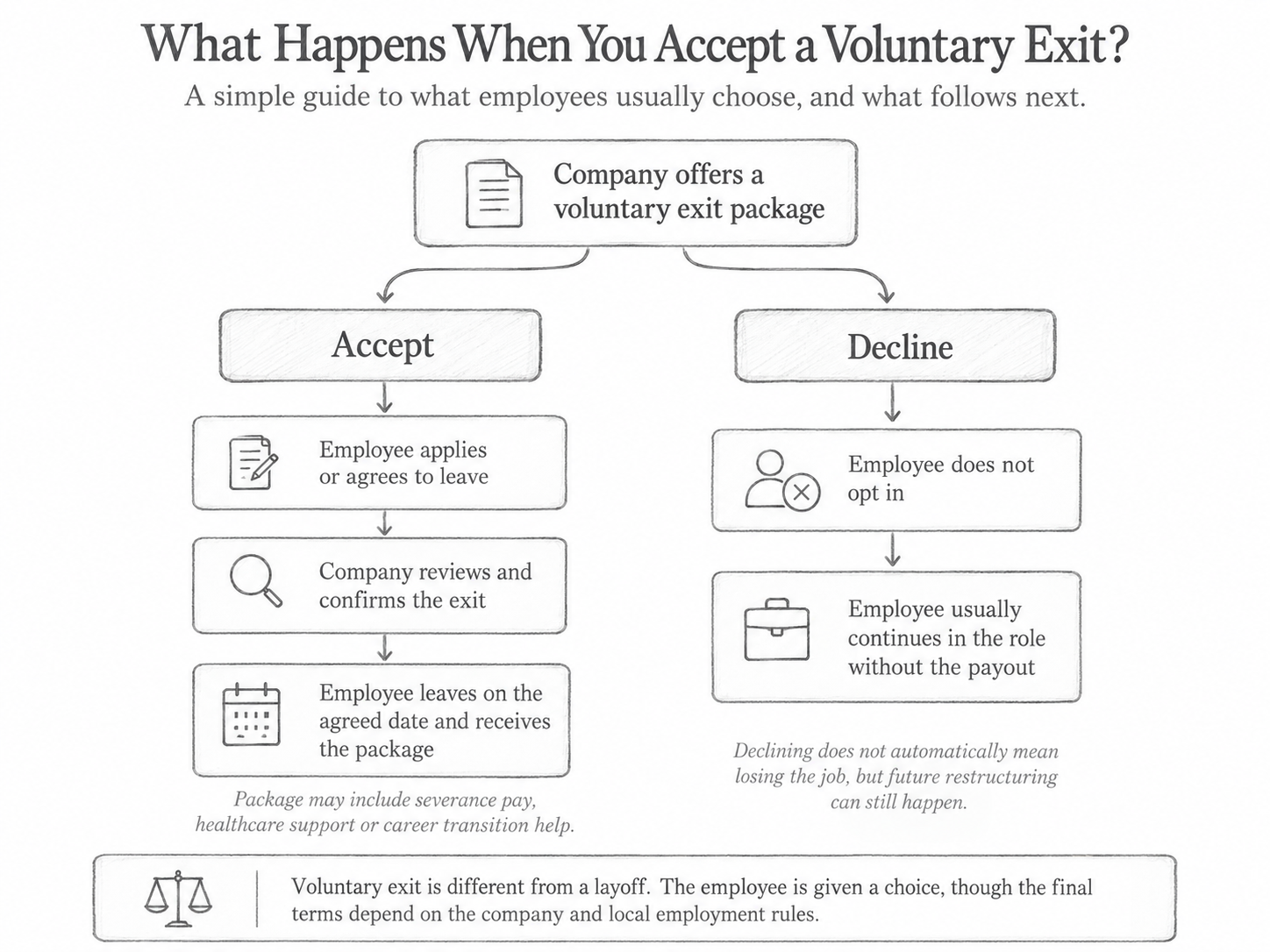
A voluntary exit, often called a buyout, works differently from a layoff. Instead of telling an employee that their job is ending, the employer offers money and sometimes additional benefits if they agree to leave by a specified date.
An employee considering retirement, a career switch or a break might find the package useful. A company, meanwhile, can reduce its wage bill or reorganise teams without making every departure compulsory. In India, a related approach is familiar as the Voluntary Retirement Scheme, or VRS, although its eligibility rules can be quite different.
If an employee volunteers and the company approves the departure, they leave under the agreed terms, usually after completing the required paperwork, and receive the promised compensation. Some programmes reserve the right to reject volunteers in essential roles. If an employee declines, they ordinarily keep their job and receive no exit payment. Saying no does not automatically trigger dismissal, but it is not a promise of lifelong employment either.
A company can still restructure or announce layoffs later, subject to employment laws. The final terms can vary by country, seniority and length of service, so accepting a buyout is more involved than clicking 'yes' on an HR email.
Microsoft has not published a universal payout for everyone eligible. In India, where it employs about 23,000 people, PTI reports that eligible staff have until 1 December to decide. The package is understood to include one month's base salary for every completed year of service, alongside healthcare and career transition support. The company has also not disclosed how many of its India-based staff qualify.
But why would a profitable company spend money to get people off its payroll? Because the cost of a buyout is usually paid once, while salaries, bonuses and benefits continue year after year. If a role no longer fits a company's plans, the upfront bill can make financial sense over time. Voluntary programmes can also be less disruptive than large compulsory layoffs. But they are hardly risk-free. The employees who choose to go may be the very ones a company wants to keep, leaving gaps in experience that are expensive to fill.
Verizon faced a similar calculation in 2018 as it reorganised its business for 5G. The US telecom company offered voluntary separation packages to about 44,000 employees, and roughly 10,400 eventually left. Depending on tenure, the package could be worth up to 60 weeks of salary, plus bonuses and benefits. Verizon recorded a $1.8 billion severance charge that year, mainly relating to the programme and other workforce reductions. It had to spend a substantial amount immediately to pursue a different cost structure over the longer term.
India has seen a much larger example at BSNL. As part of a government-backed revival effort, 78,569 employees took voluntary retirement and left in January 2020. Government figures show that BSNL's salary spending fell by roughly half. Yet lower employee costs did not, by themselves, deliver a competitive telecom business. BSNL still had to address its network, technology and financing challenges. Cutting the wage bill can create breathing room; what a company does with that room determines whether the restructuring succeeds.
Microsoft already has some experience with the trade-off. Earlier this year, it offered a voluntary retirement programme to about 8,750 eligible US employees, and more than 30% accepted. It then announced 4,800 job cuts in July, while saying the earlier retirements had helped reduce the need for further layoffs. This latest offer is much broader and, unlike the retirement scheme, is not based on age or years of service. Microsoft has said it expects a smaller share to accept this time.
The company is clearly changing how it allocates people and money. But a voluntary offer in the Copilot division does not mean a chatbot has made a particular employee redundant, any more than Verizon's buyouts meant 5G had replaced its staff.
Microsoft will still need people to build products, run data centres and turn its expensive infrastructure into a business customers are willing to pay for. How many employees choose to leave, which skills the company retains and whether future layoffs follow will reveal more about this reorganisation than the 60,000 figure alone.