

 Newsletter
If you look at what India sells to the United States today, the list might surprise you. Not too long ago, the story was simple. India exported garments, diamonds, and textiles.
That was the stereotype of Indian exports for decades. But the latest trade numbers tell a very different story.
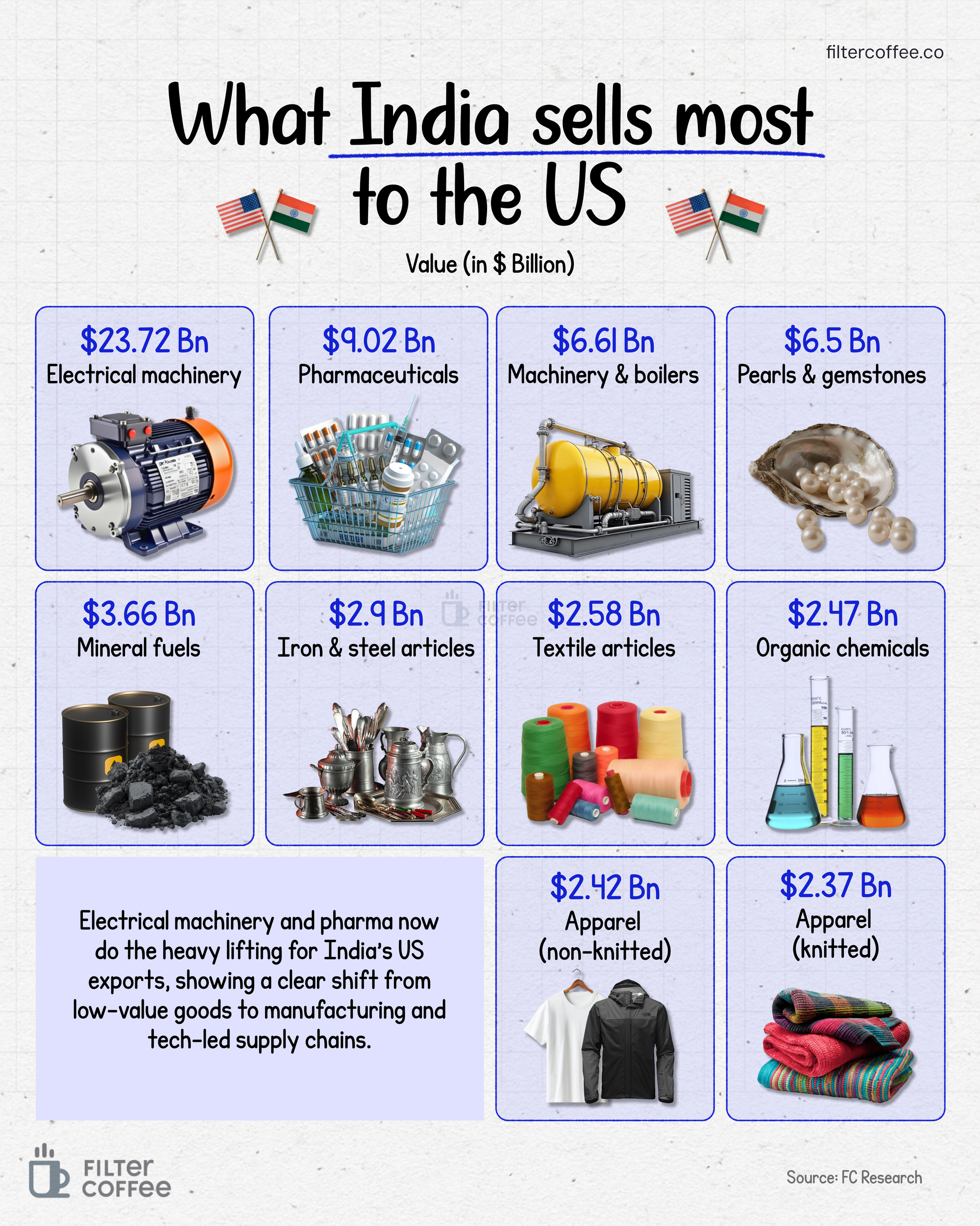
Electrical machinery alone now accounts for roughly $23.7 billion of India’s exports to the US, making it the single largest category. Pharmaceuticals come next at about $9 billion, followed by machinery and engineering equipment worth over $6.6 billion.
Gems and jewellery are still significant at about $6.5 billion, but they are no longer the centrepiece of the relationship. Quietly and steadily, India’s export basket to the US has shifted from labour-intensive goods to manufacturing, technology, and industrial products.
In fact, United States is now India’s largest trading partner, with total bilateral trade crossing $132 billion recently. Out of this, India exported goods worth around $86 billion to the US, giving India a trade surplus of roughly $40 billion. In simple terms, India sells far more to America than it buys from it.
And the composition of those exports reveals how India’s economy itself is evolving.
The biggest story here is electronics.
Over the past five years, India has quietly emerged as a major manufacturing hub for smartphones and electronic components. The government’s production-linked incentive schemes encouraged global companies to assemble devices in India, and companies like Apple, Foxconn, and Pegatron responded.
Today, India exports tens of billions of dollars worth of electronics globally, and the US is one of the biggest destinations. At one point last year, smartphone shipments from India to the US crossed $965 million in a single month, reflecting just how quickly this ecosystem is scaling up.
What used to be a country known for outsourcing software is now increasingly becoming a place where physical electronics are manufactured and exported.
Pharmaceuticals tell a different but equally powerful story.
India is often called the “pharmacy of the world,” and the US healthcare system relies heavily on Indian generic medicines. Indian companies supply a massive share of affordable drugs used by American hospitals and pharmacies.
Generics from firms like Sun Pharma, Dr. Reddy’s, Cipla, and Aurobindo Pharma help keep healthcare costs down in the US. That’s why pharmaceutical exports from India to the US consistently hover around the $8–9 billion range every year, making it one of the most stable pillars of the trade relationship.
Engineering goods and industrial machinery are another fast-growing segment. These exports include everything from mechanical equipment to components used in factories, power plants, and infrastructure projects.
Globally, India’s engineering exports have crossed $100 billion annually, reflecting the country’s growing role in global manufacturing supply chains. When American companies look for alternative suppliers outside China, India is increasingly becoming one of the obvious choices.
Yet not everything has changed. Some of India’s traditional export sectors still remain important. Gems and jewellery, especially polished diamonds from Surat, continue to find a large market in the US.
India still dominates the global diamond cutting and polishing industry, handling a majority of the world’s stones before they reach jewellery stores. Textiles and apparel also remain a steady export category, including cotton garments, knitwear, and home textiles like bed linen and towels. However, their relative importance has gradually declined as electronics and engineering products grow faster.
This transformation also reflects a deeper shift in global supply chains. For years, China dominated manufacturing exports to the US. But rising geopolitical tensions, supply chain disruptions during the pandemic, and the push for diversification have pushed American companies to look for alternative manufacturing hubs.
India, with its large labour force, improving infrastructure, and government incentives, has become one of the beneficiaries of this realignment. The result is visible in the export numbers. Instead of shipping mostly low-value goods, India is increasingly exporting products that sit higher up the value chain.
Of course, the relationship is not entirely smooth. Trade disputes occasionally flare up. The US has raised concerns about subsidies in sectors like solar manufacturing and has considered imposing duties on certain imports from India. At the same time, Indian exporters face tariff challenges in categories like textiles and jewellery. These tensions are part of a broader global trade landscape where countries are constantly negotiating market access and protecting domestic industries.
But despite these frictions, the broader trend is unmistakable. India’s export relationship with the US is expanding and diversifying. More than 7,000 different products now move from Indian factories to American consumers every year. And the mix of those products tells a story about where India’s economy is heading.
A few decades ago, India’s export identity was tied to cotton shirts, carpets, and diamonds. Today, it increasingly includes electronics, pharmaceuticals, engineering equipment, and chemicals. The shift may look gradual when you see the numbers year by year, but over time it marks a significant transformation. It signals that India is slowly moving from being a supplier of labour-intensive goods to becoming a participant in modern manufacturing supply chains.
And if the current trajectory continues, the biggest exports to the United States in the future may not be garments or gems at all. They could be smartphones, electronic components, medical technologies, and advanced industrial equipment. In other words, the story of what India sells to America is quietly becoming a story about how India itself is changing.