

 Newsletter

India’s youngest borrowers are taking loans faster than ever before.
According to TransUnion CIBIL, nearly 41% of first-time borrowers in the country are now Gen Z, a sign that India’s credit boom is increasingly being driven by people in their early twenties.
For most Indians, debt used to arrive late in life. You studied first, got a stable job, saved for years and then maybe took a home loan or bought a vehicle on EMI.
Borrowing was tied to something big and long term. But that equation is changing fast. Today many young Indians are entering adulthood with EMIs even before their first stable salary hits the bank account.
And the numbers are beginning to show just how silently things are shifting for a country where earlier generations were often taught to avoid debt unless absolutely necessary.
What makes this even more interesting is that Gen Z still has relatively low credit penetration overall. This makes it a story about how India’s economy, technology and urban lifestyle have changed together.
Start with city life. Rent in large Indian cities has surged sharply after the pandemic. Transportation costs are up. Eating out is expensive. Even basic social life in metros now comes with a price tag.
Entry-level salaries, meanwhile, have not grown at the same speed. So young earners are increasingly using credit not for luxury alone, but to smooth everyday life. At the same time, borrowing itself has become frictionless.
A decade ago, taking a loan meant paperwork, bank visits and long waiting periods. Today credit appears inside apps people already use daily.
Buy Now Pay Later options are available while checking out food orders, gadgets or fashion purchases. Credit cards can now be linked directly to UPI. EMIs can be activated in minutes. Borrowing feels like a payment option.
That psychological shift may be the most important part of this story.
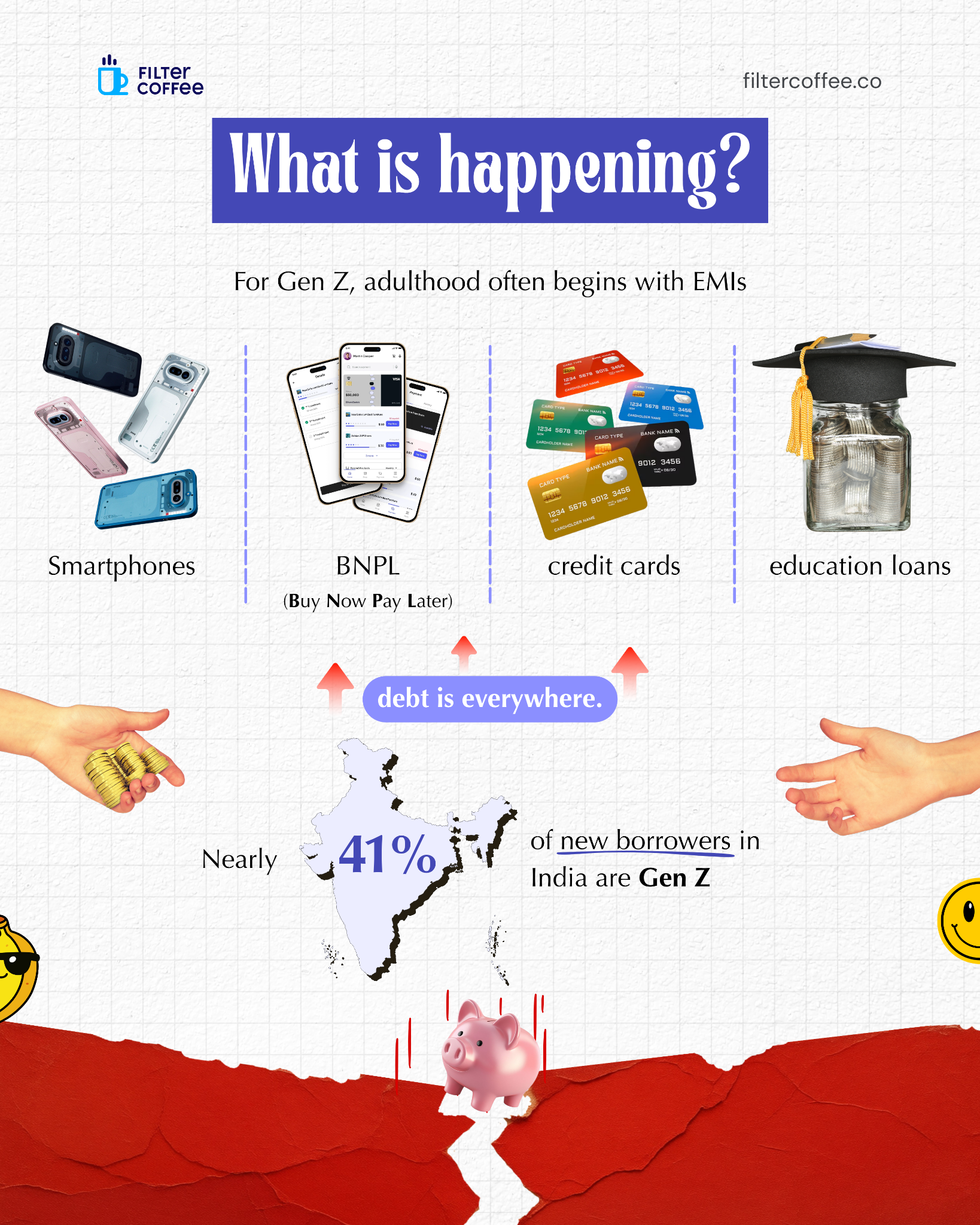
RBI data now shows that over 55% of household debt in India comes from non-housing loans, meaning consumption loans are becoming bigger than traditional asset-building loans. People are increasingly borrowing for phones, travel, shopping and lifestyle spending instead of homes or long-term investments. India’s credit culture is moving from “build assets slowly” to “consume now and pay later.”
And social media is amplifying this behavior every single day.
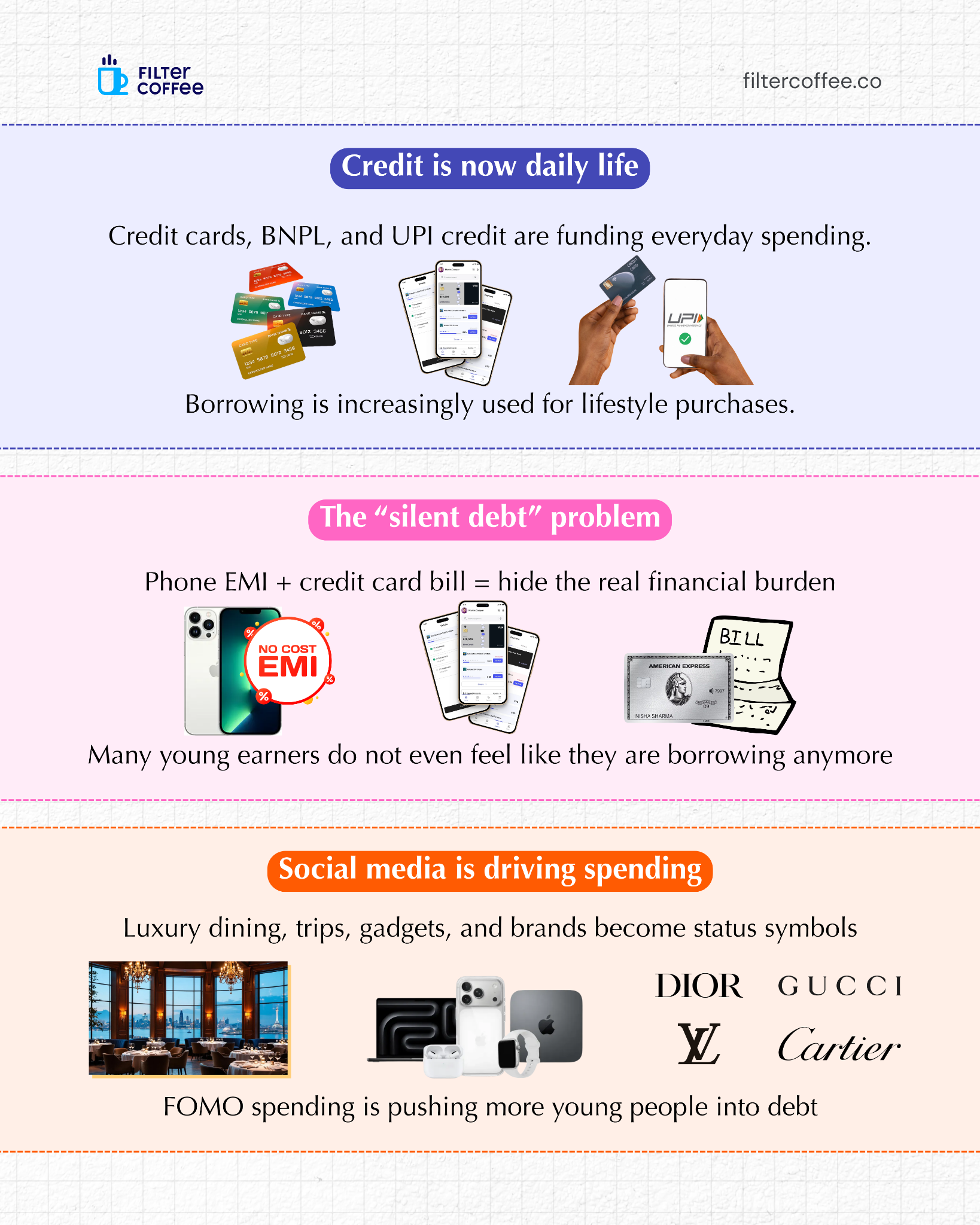
Instagram, YouTube and influencer culture constantly push aspirational lifestyles into people’s screens. Luxury cafes, international vacations, sneakers, gadgets and premium brands are presented as normal urban life. The pressure to keep up is subtle but powerful. A flagship smartphone becomes a social signal. Travel becomes identity. Dining becomes content. Consumption becomes visibility.
This is where the “silent debt” problem begins.
A ₹2 lakh loan sounds serious. But a ₹3,999 monthly EMI does not. Small monthly payments psychologically shrink large purchases.
Multiple subscriptions, EMIs, BNPL payments and card dues slowly stack together until the financial burden becomes difficult to fully track. Many young earners do not even feel like they are in debt anymore because the repayment experience has become so embedded into everyday digital life.
The data already hints at rising stress underneath this system. Fintech industry data showed overdue rates on digital personal loans rising in 2025, especially in small-ticket lending.
RBI has also tightened rules around digital lending platforms, signalling that regulators are becoming increasingly cautious about how aggressively easy credit is spreading.
And yet, this borrowing boom is not entirely negative.
From the economy’s perspective, rising credit access also means millions of young Indians are entering the formal financial system for the first time.
Responsible borrowing can help build credit scores early, improve access to future loans and increase financial inclusion. India’s digital public infrastructure, especially UPI, has made financial access faster and wider than ever before.
The problem begins when convenience overtakes caution.
India is creating a generation that can access credit instantly, but financial literacy has not scaled at the same pace. Schools rarely teach how interest compounds, how credit scores work or how long-term debt traps form. So many young borrowers are learning about finance only after repayments start piling up.
That is what makes this moment so important.
This is a deeper economic shift where technology, aspiration, urban inflation and instant digital finance are reshaping how young Indians think about money itself.
Earlier generations saw debt as a burden to avoid but Gen Z is growing up in an economy where debt increasingly feels invisible, normal and sometimes even necessary.